Four exercises, about five minutes. For the sadness that sits there and will not come out.
4 exercises · about 5 minutes · nothing to buy, nothing to install
Short answer
Crying is a movement of the whole body: ribs, diaphragm, throat, face. When something in you decides not to, those parts hold instead. That holding is the weight you feel high in the chest.
When the tears will not come, and that is somehow worse
There is a sadness that cries and a sadness that does not. The second one is heavier. It sits high in the chest, makes your breathing shallow without you noticing, and turns the whole day slightly grey.
Crying is a movement of the whole body. Ribs, diaphragm, throat, face, all of it. When something in you decides not to, those parts hold instead. That holding is what you feel as weight.
It is worth saying plainly: the goal here is not to make you cry. Sometimes that happens and it is fine. The goal is to give the chest somewhere to move so it is not carrying the whole thing alone.
Go gently with these. Sadness responds badly to being forced and well to being kept company.
The exercises
Do them in this order and go slowly. If something feels like too much, stop and
breathe. That is part of the practice, not fine print.
Perception
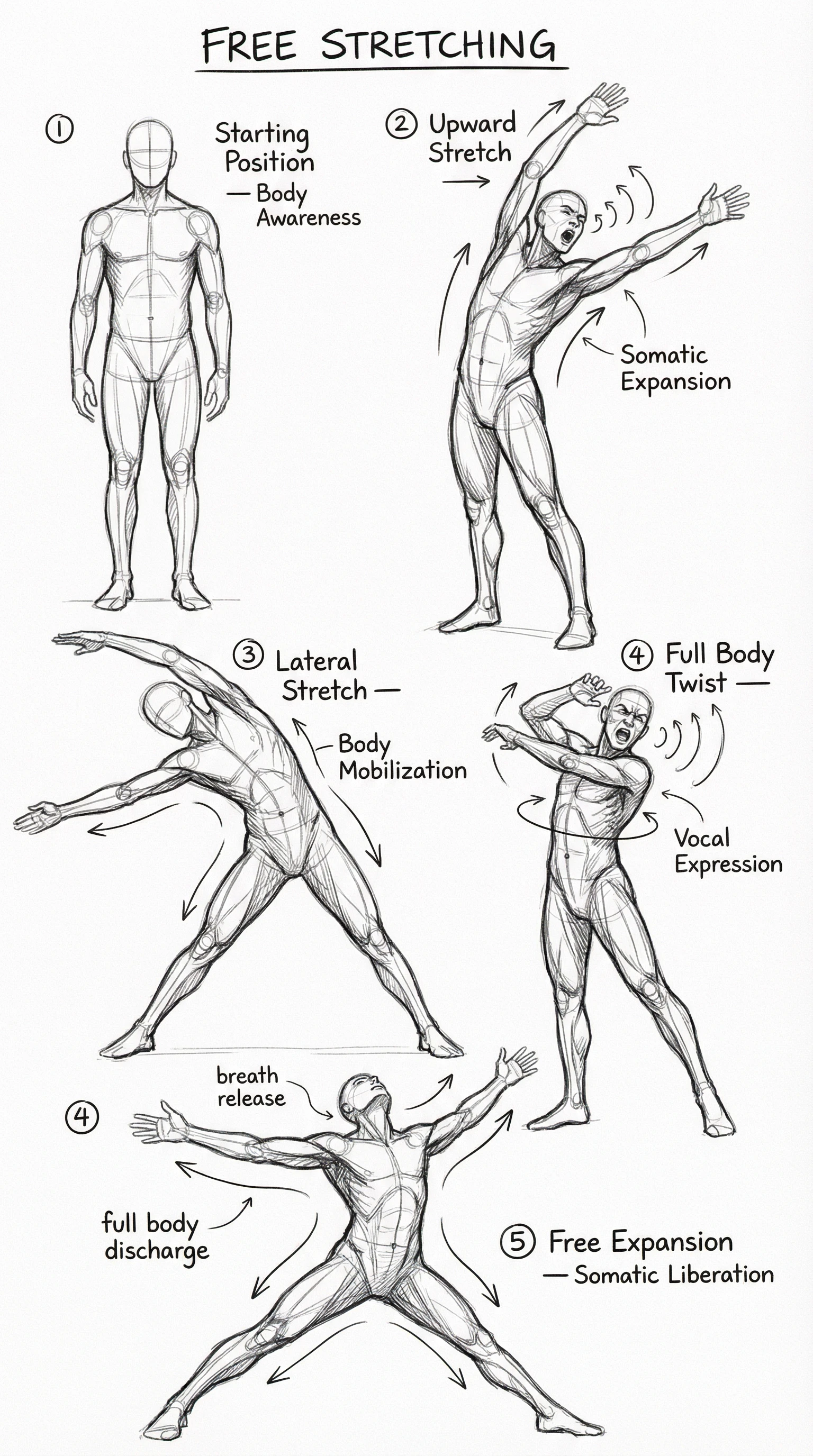
Free Stretch
“my body knows what to do to transform my physical, energetic and emotional states”
Stretch freely, expanding your body to its fullest. Use every possible direction of movement — upward, sideways, downward, and beyond. Engage your arms, legs, head, and torso. Leave nothing out; mobilize everything! Move, lengthen, and push your body so it is no longer confined — expand its possibilities. Make faces and let out sounds. It is very important to release the breath as you stretch. If you can do it vocally, even better.
Use it when
when you want to expand your aliveness and release tensions globally, quickly and easily
What it is for
create new body shapes in an expressive and expansive way
Straight at it
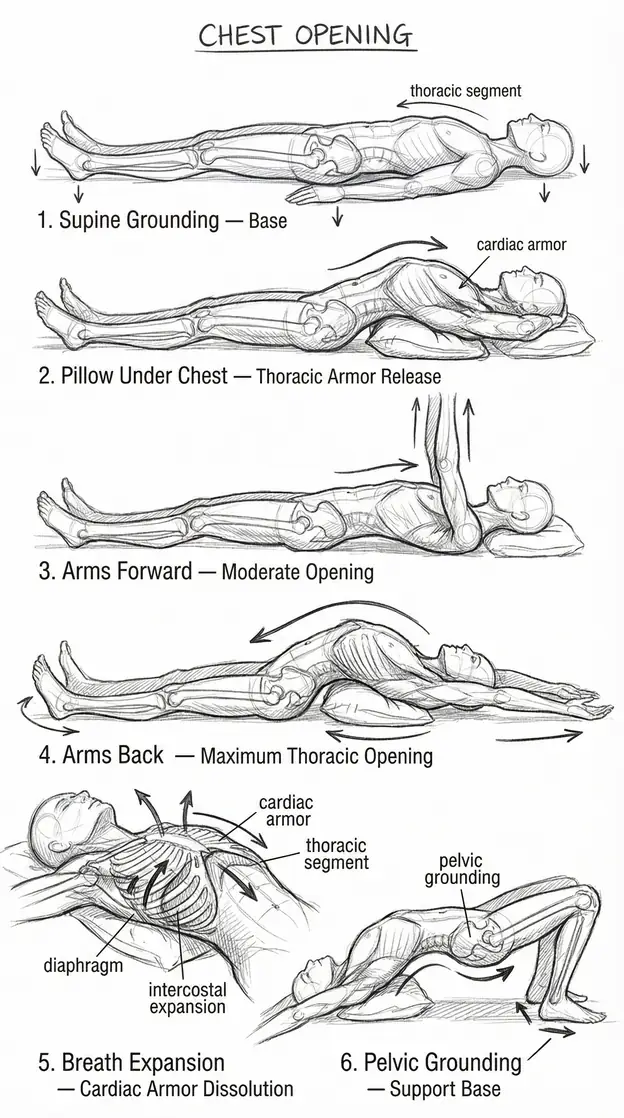
Chest Opening on Cushion
“I can release the emotional weight from my heart”
Lie on a firm surface in grounding position (on soft surfaces — such as a bed — the effects are reduced, but it is still valid and possible). Close your arms in front (less open) or stretch them back (more open), with your head resting on the floor. You may also use your arms to apply gentle pressure to your head. Always keep your hip, feet, and shoulders on the floor. Breathe deeply, releasing and letting air out through your mouth. When finished, find the most relaxed position possible. You may gently rock or mobilize the chest area if needed. Allow both the thoracic muscles and any trapped breath to release and let go.
Use it when
when you want to decompress emotions held in tension in the chest
What it is for
open the heart; decompress feelings; make affective contact with the body; discharge the pressures held in the chest
Working around it
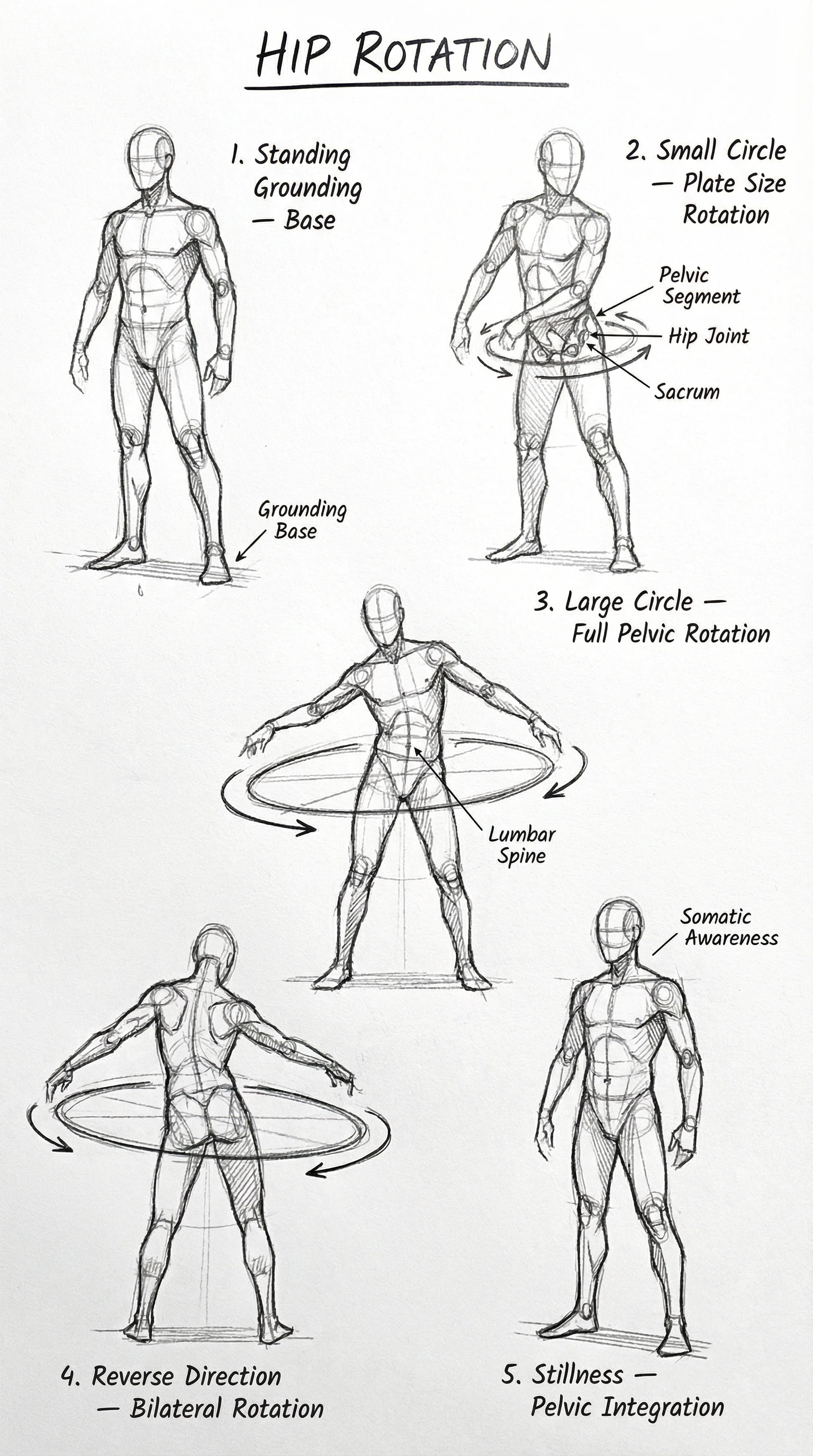
4D Hip Movement
“I can feel, move, and enjoy my aliveness”
In standing grounding, move the pelvis laterally as if making a hip-point movement. Move consciously and breathe. Let the weight of your body drop into your legs, bringing presence and integration. Feel and claim your hip/pelvis. Then move forward and back — pushing the pelvis back and tucking it forward in a figure-eight or wave-like motion. Breathe deeply; if possible, inhale as you retract and exhale as you push forward. Let yourself release, feel, notice, and simply be in your pelvis. When finishing, find the center of the pelvis in grounding and breathe into it. Be mindful not to contract your mouth, chest, or neck during this exercise. Whenever you notice yourself 'holding up top,' let go there so you can also let go below.
Use it when
when you want to ground, integrate, and vitalize your body
What it is for
to claim, mobilize, and activate the presence of the hip and pelvis
Centring
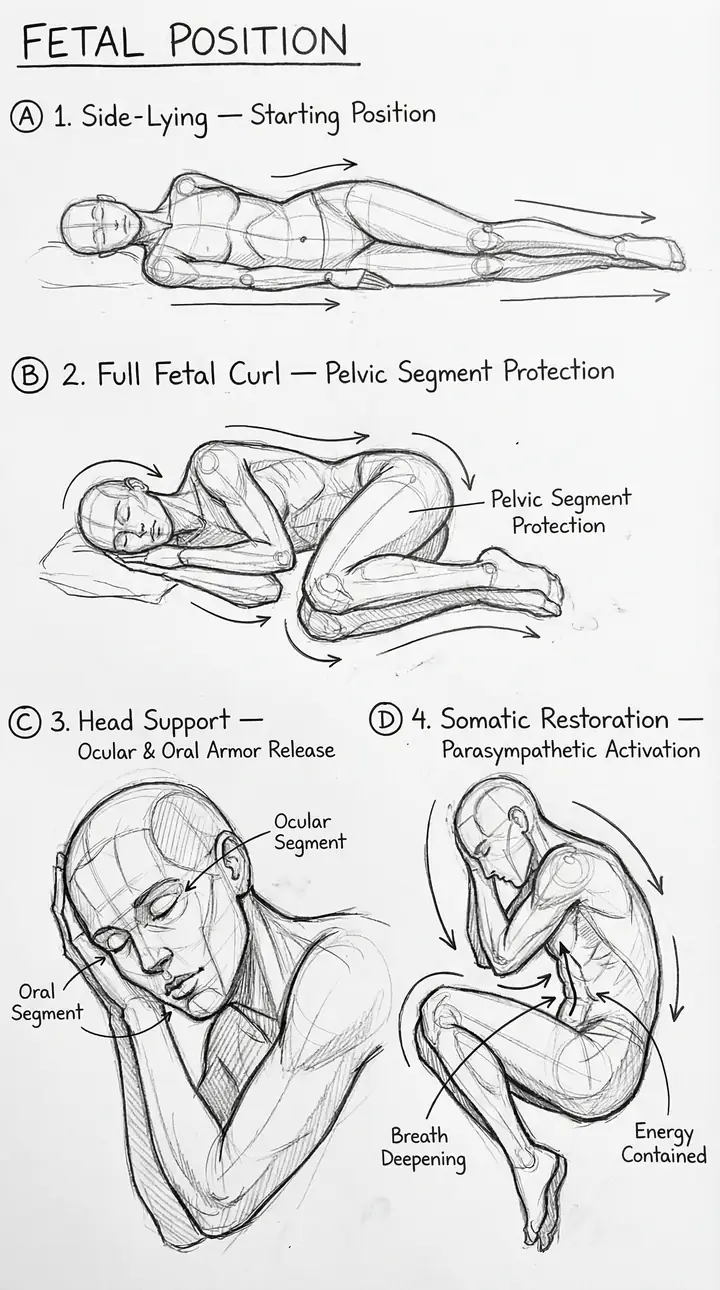
Fetal Position
“I can always access my nest”
Lie comfortably on your side with legs drawn in and your trunk slightly curled toward your legs (fetal position). Use your arms to support your head in whatever way feels most comfortable, or adjust other body parts as needed — shoulders, face. Breathe deeply and rest in this place.
Use it when
when it is necessary to enter a highly protected and nurturing space
What it is for
to restore, momentarily close off from the world, pause, recover strength, and protect yourself
About the order. It looks shuffled and it is meant to be. Going straight at the tense place and staying there can bring up more than you were ready for, so the sequence pulls away, works somewhere else, and then comes back to close. The order is part of the protocol, not a detail.
Where this comes from
Boyesen's biodynamic work is the closest reference here: release that is allowed rather than forced, which is why nothing on this page pushes for catharsis.
Body Anchor’s method is inspired by four foundational thinkers in
body-based psychotherapy. Their work is the lineage every sequence on this
site sits in.
Wilhelm Reich — Character analysis and the concept of muscular armor.
Alexander Lowen — Bioenergetic analysis and grounding-based bodywork.
David Boadella — Biosynthesis approach connecting movement and emotional process.
Gerda Boyesen — Biodynamic psychology and gentle somatic release work.
Questions people ask
Why can I not cry even though I feel sad?
Crying is a movement of the whole body: ribs, diaphragm, throat, face. When something in you decides not to, those parts hold instead. That holding is the weight you feel high in the chest.
Is the goal to make me cry?
No. Sometimes it happens and that is fine. The point is to let the chest move again so it is not carrying the whole thing alone.
Sadness was one answer. What is yours?
The app asks what you feel and where you feel it, then builds the protocol for that exact pair. 218 exercises, three to ten minutes.