Four exercises, about five minutes. For the anger that never made it out of your body.
4 exercises · about 5 minutes · nothing to buy, nothing to install
Short answer
Because anger is a movement before it is a feeling. The impulse to push or say the thing loads into the arms, shoulders and jaw. Stop it at the last second and the muscles stay loaded. The feeling lingers because the movement never finished.
The argument ended. Your body did not get the memo.
You did not shout. You stayed reasonable, you picked your words, you let it go. And two hours later your jaw is tight, your arms feel wired, and you are replaying the whole thing in the shower.
Anger is a movement before it is a feeling. It wants to push, to strike, to say the thing. When you stop it at the last second, the impulse does not evaporate. It stays in the muscles that were about to carry it out, mostly the arms, the shoulders, the jaw, the back.
That is why talking yourself down so rarely works. You are reasoning with a body that is still mid-gesture.
What follows does not ask you to express anything at anyone. It gives the movement somewhere to go, on its own, in your own room. Notice first, then push, then step away from it, then settle.
The exercises
Do them in this order and go slowly. If something feels like too much, stop and
breathe. That is part of the practice, not fine print.
Perception
Self-Awareness
“everything is here”
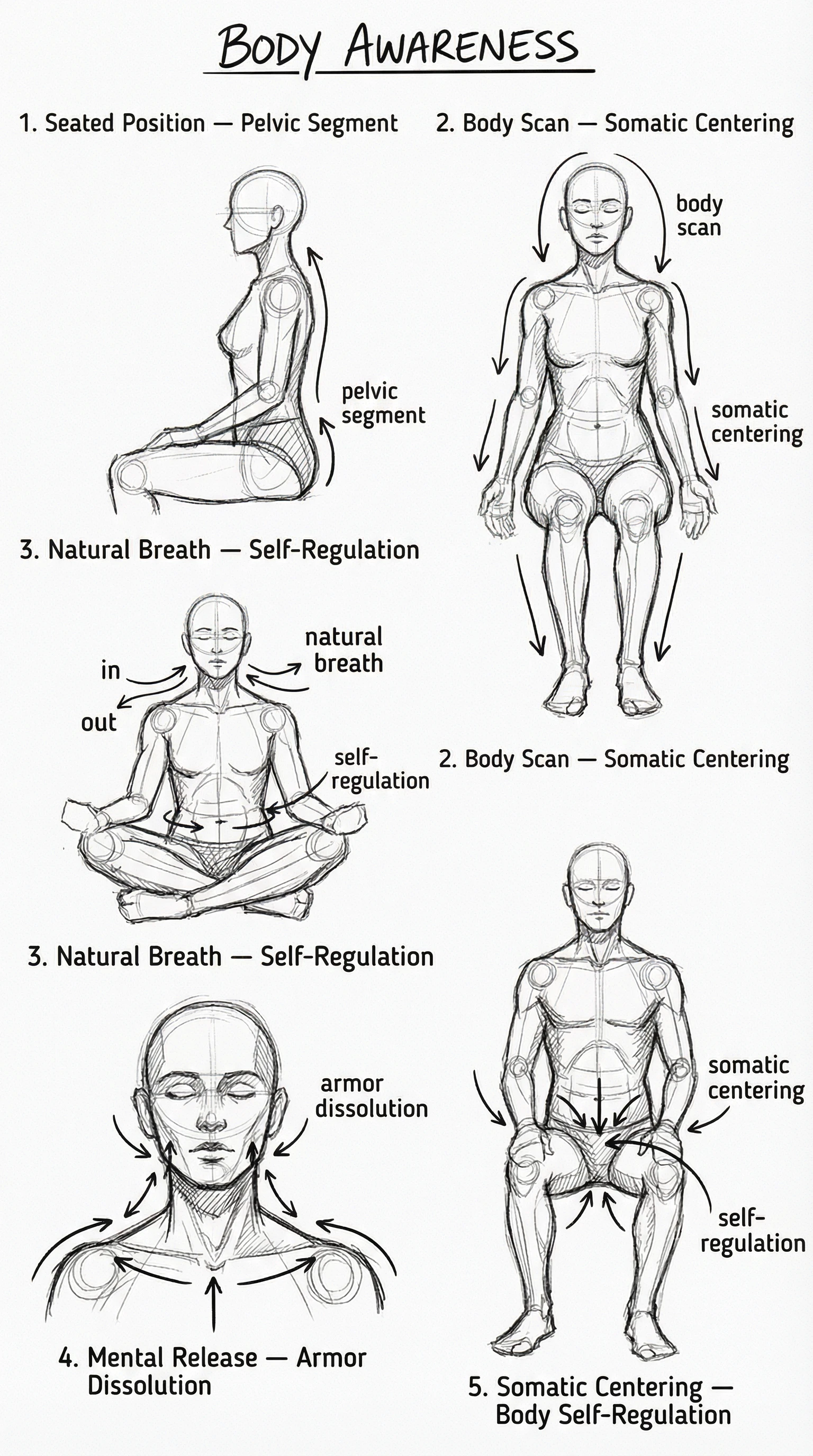
Position yourself comfortably. Keep the spine upright with minimal effort. Breathe naturally. Release perceived tensions through gentle mental intention, allowing self-regulation to arise organically.
Use it when
when you want to perceive and centrate yourself
What it is for
perceive yourself; allow the body to self-regulate through awareness and breath
Straight at it
Full Body Strike
“I can deliver my aliveness in full expression”
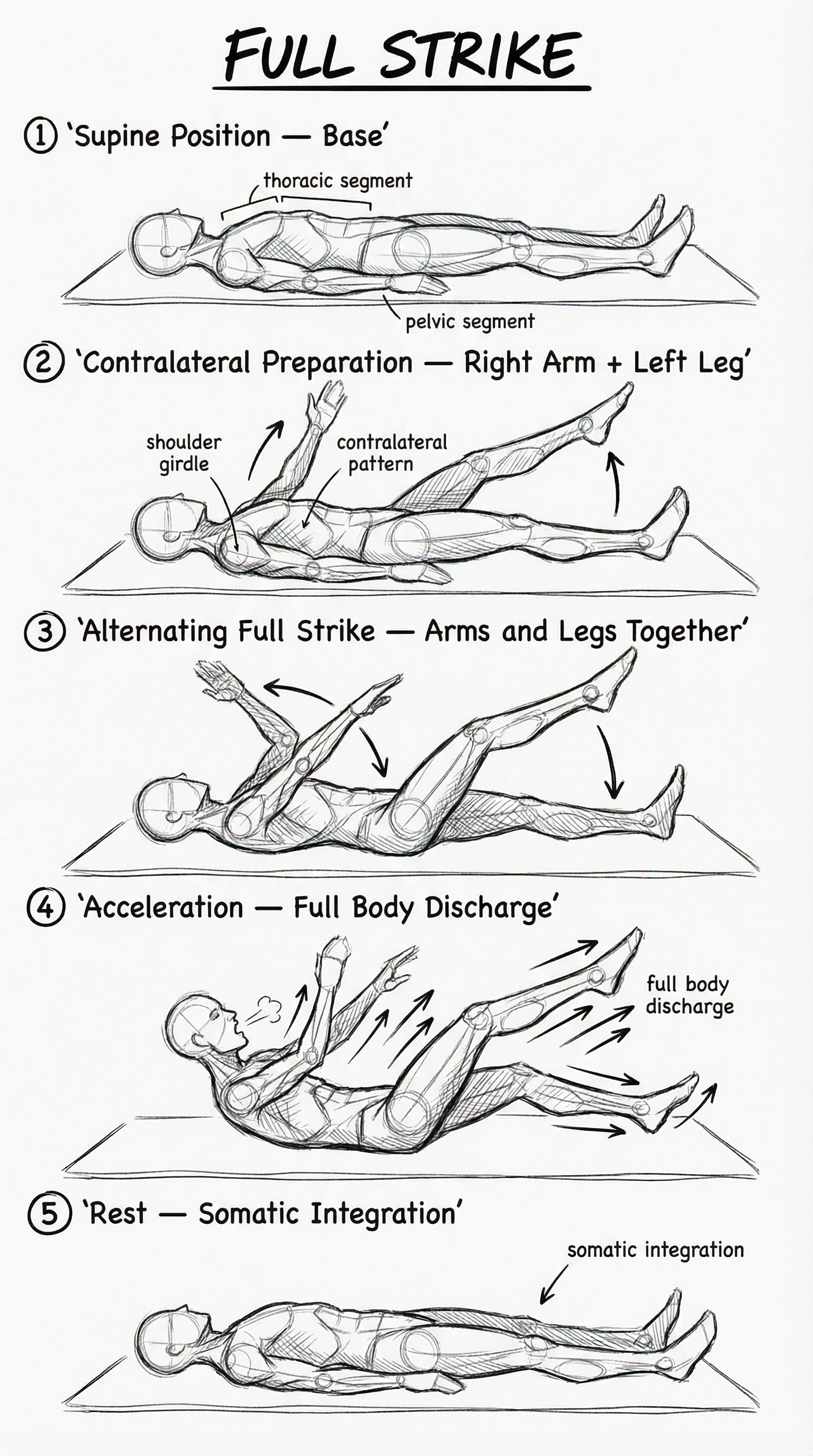
Lying on a bed, alternate striking your legs to hammer the mattress rhythmically; breathing through the mouth follows naturally. Pause and repeat, experimenting with quickening the 'aaahh' sound and intensifying the strikes. Make them a little more forceful. Before exhaustion sets in, pause and observe your sensations. Is there something being expressed in this exercise? What word captures your expressive movement during the striking? Allow discharge to complete, then recover and reorganize.
Use it when
when you want to discharge emotional tension and restore aliveness
What it is for
restore aliveness; discharge accumulated tension and recharge the body's energy
Working around it
Oral Touch
“I can embrace my needs, fragilities, and sensitivities”
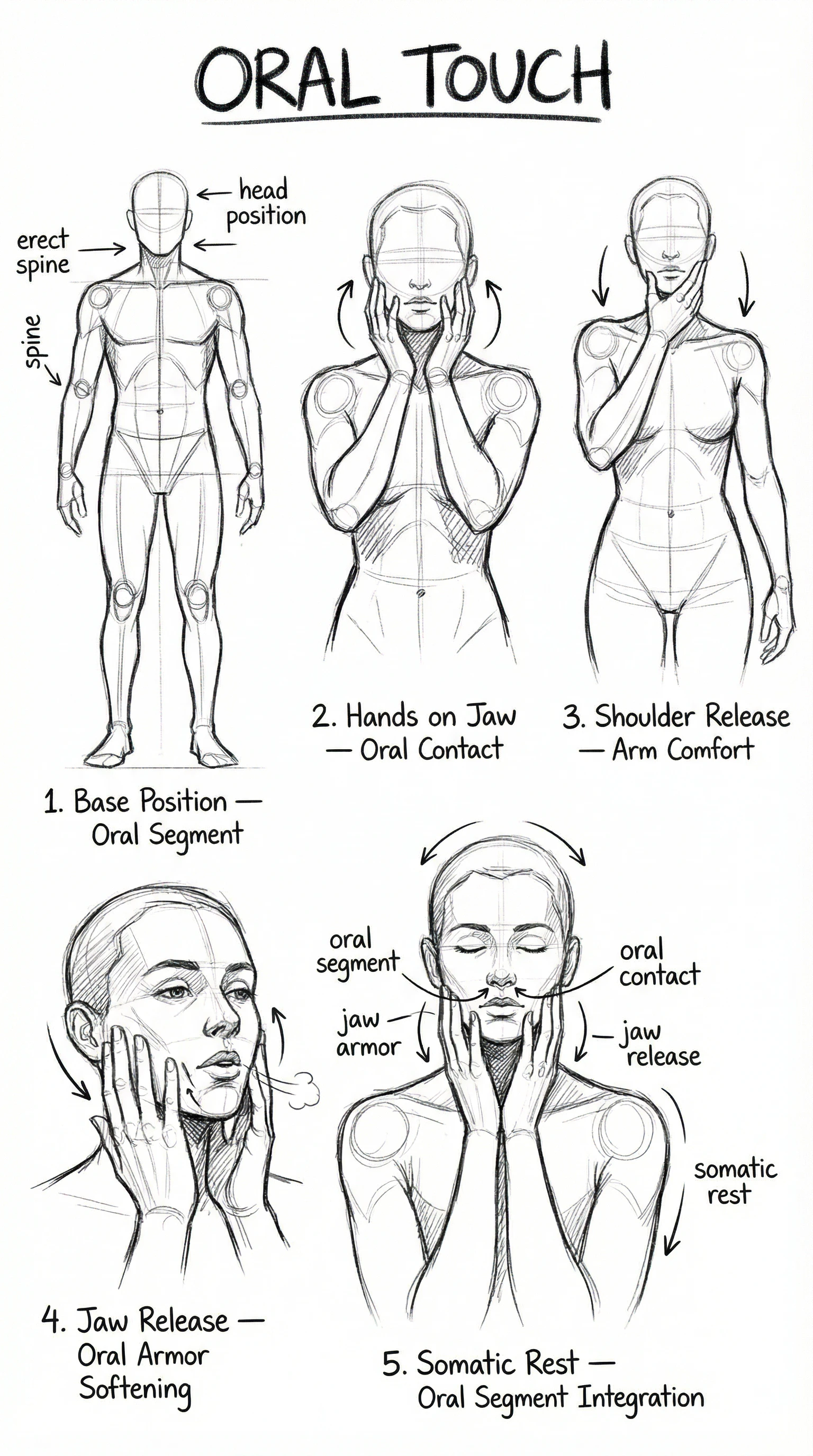
Touch the jaw region, feeling the gentle and comforting presence of your hands. Relax your shoulders and settle your arms. Prioritize the exhale to release tension. You may close your eyes to deepen the connection with yourself. Stay in this position for at least 1 to 2 minutes.
Use it when
when you want to soothe and calm fears and anxieties
What it is for
to welcome, embrace, soothe, gather inward, and reestablish
Centring
Pulsation in Standing Grounding
“I can let life happen inside me”
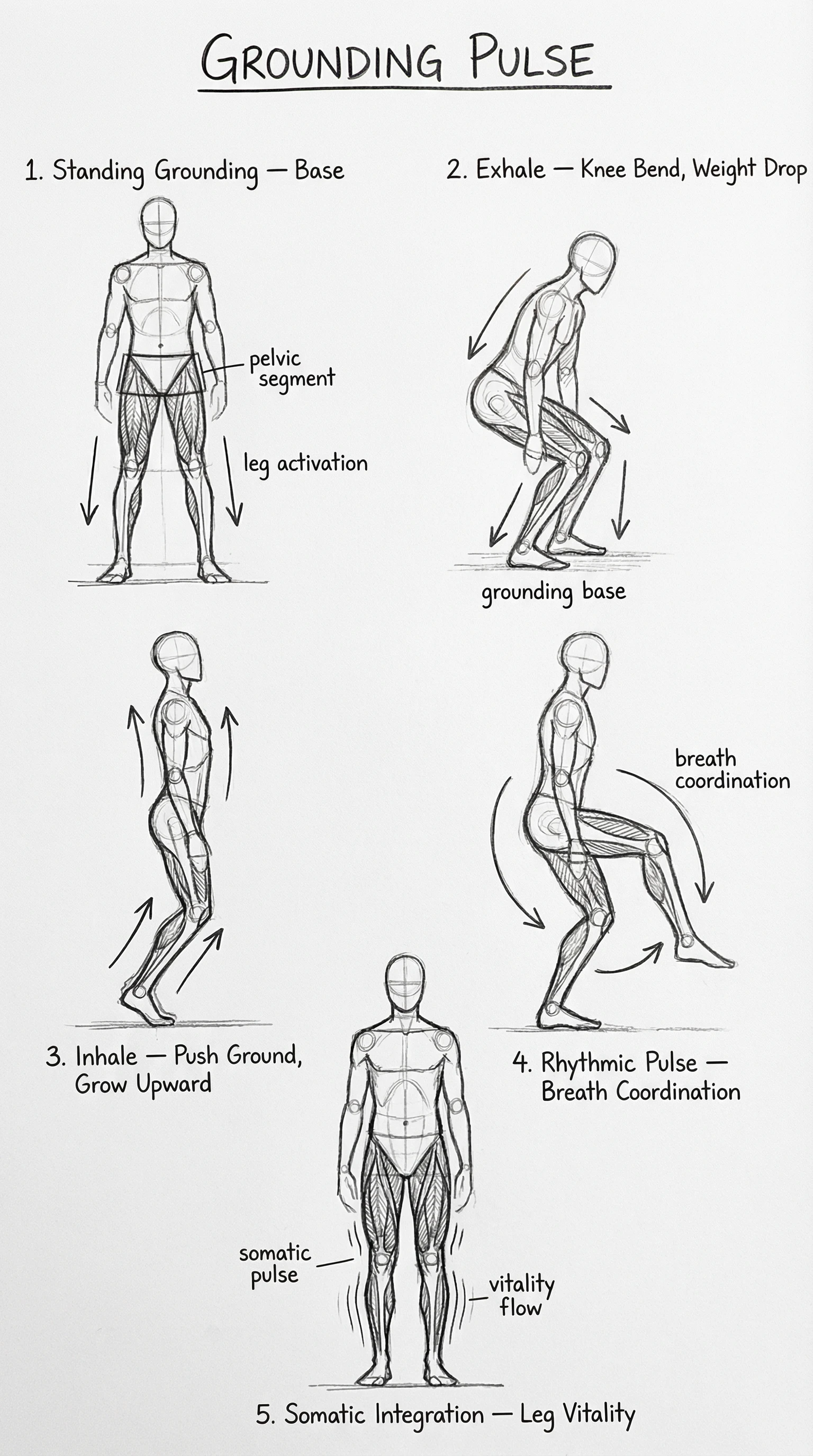
Stand with feet parallel and knees slightly bent (standing grounding). On the exhale, bend your knees a little more so that your weight increases in your legs and feet. On the inhale, gently rise. Maintain the connection with your body weight dropping downward toward the ground. Do this in a rhythmic, focused way — feeling gravity ground you on the exhale and lift you on the inhale. Gradually find a core axis of balance within this pulsation, relaxing and anchoring your spine at the center of your body. Your hands can follow the movement or rest relaxed at the sides of your body.
Use it when
when you want to connect deeply with your body
What it is for
to ground, reestablish the energy line in the body, integrate, organize, and center
About the order. It looks shuffled and it is meant to be. Going straight at the tense place and staying there can bring up more than you were ready for, so the sequence pulls away, works somewhere else, and then comes back to close. The order is part of the protocol, not a detail.
Where this comes from
The idea that a stopped impulse stays in the muscle that was about to carry it is Reich's. The discharge work through the arms and back comes out of Lowen's bioenergetics.
Body Anchor’s method is inspired by four foundational thinkers in
body-based psychotherapy. Their work is the lineage every sequence on this
site sits in.
Wilhelm Reich — Character analysis and the concept of muscular armor.
Alexander Lowen — Bioenergetic analysis and grounding-based bodywork.
David Boadella — Biosynthesis approach connecting movement and emotional process.
Gerda Boyesen — Biodynamic psychology and gentle somatic release work.
Questions people ask
Why do I still feel angry after the argument is over?
Because anger is a movement before it is a feeling. The impulse to push or say the thing loads into the arms, shoulders and jaw. Stop it at the last second and the muscles stay loaded. The feeling lingers because the movement never finished.
Does releasing anger mean expressing it at someone?
No. These exercises give the movement somewhere to go on its own, in your own room. Nothing here involves confronting anybody.
Anger was one answer. What is yours?
The app asks what you feel and where you feel it, then builds the protocol for that exact pair. 218 exercises, three to ten minutes.