Three exercises, a few minutes. For the loop that will not stop going round.
3 exercises · about 5 minutes · nothing to buy, nothing to install
Short answer
Because you are feeding the same machine. The loop feels mental, but underneath it a body is braced, usually around the eyes, forehead and the back of the neck. While the bracing continues, the mind keeps getting the signal that something is unresolved.
You cannot think your way out of thinking
It is three in the morning and you are solving a problem you already solved twice. Or you are in a meeting and half of you is somewhere else entirely, running scenarios.
The loop feels mental so you attack it mentally. You reason with it, you list the evidence, you tell yourself it is fine. It speeds up. Of course it does. You are feeding the same machine.
Underneath the loop there is a body that is quietly braced, usually around the eyes, the forehead and the back of the neck. As long as the bracing continues, the mind keeps getting the signal that something is unresolved, and it keeps working.
This one is short on purpose. Three exercises. You are not trying to empty your head, you are giving the body a reason to stop bracing.
The exercises
Do them in this order and go slowly. If something feels like too much, stop and
breathe. That is part of the practice, not fine print.
Perception
Self-Awareness
“everything is here”
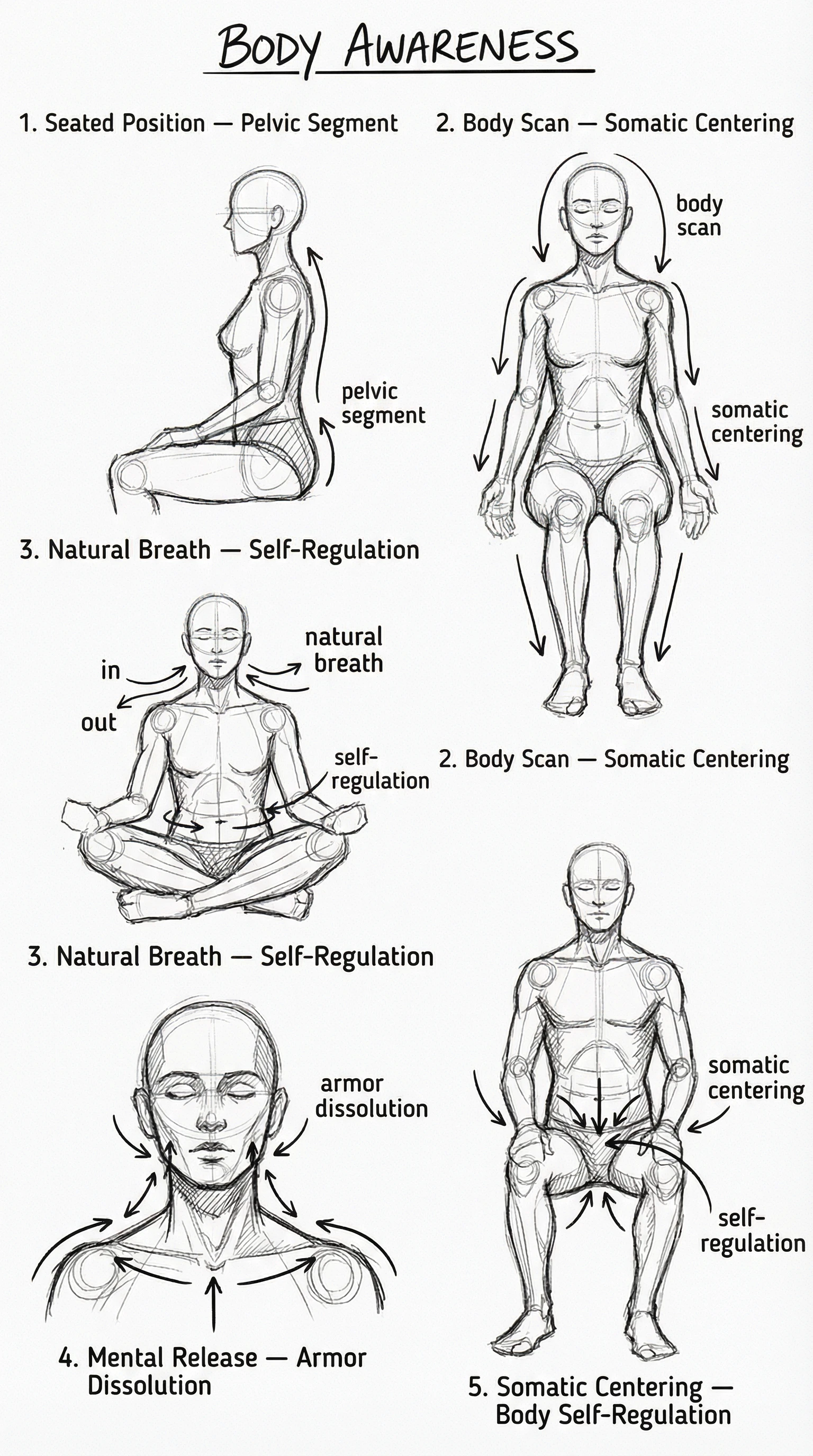
Position yourself comfortably. Keep the spine upright with minimal effort. Breathe naturally. Release perceived tensions through gentle mental intention, allowing self-regulation to arise organically.
Use it when
when you want to perceive and centrate yourself
What it is for
perceive yourself; allow the body to self-regulate through awareness and breath
Straight at it
Facial Distortion
“I can transform”
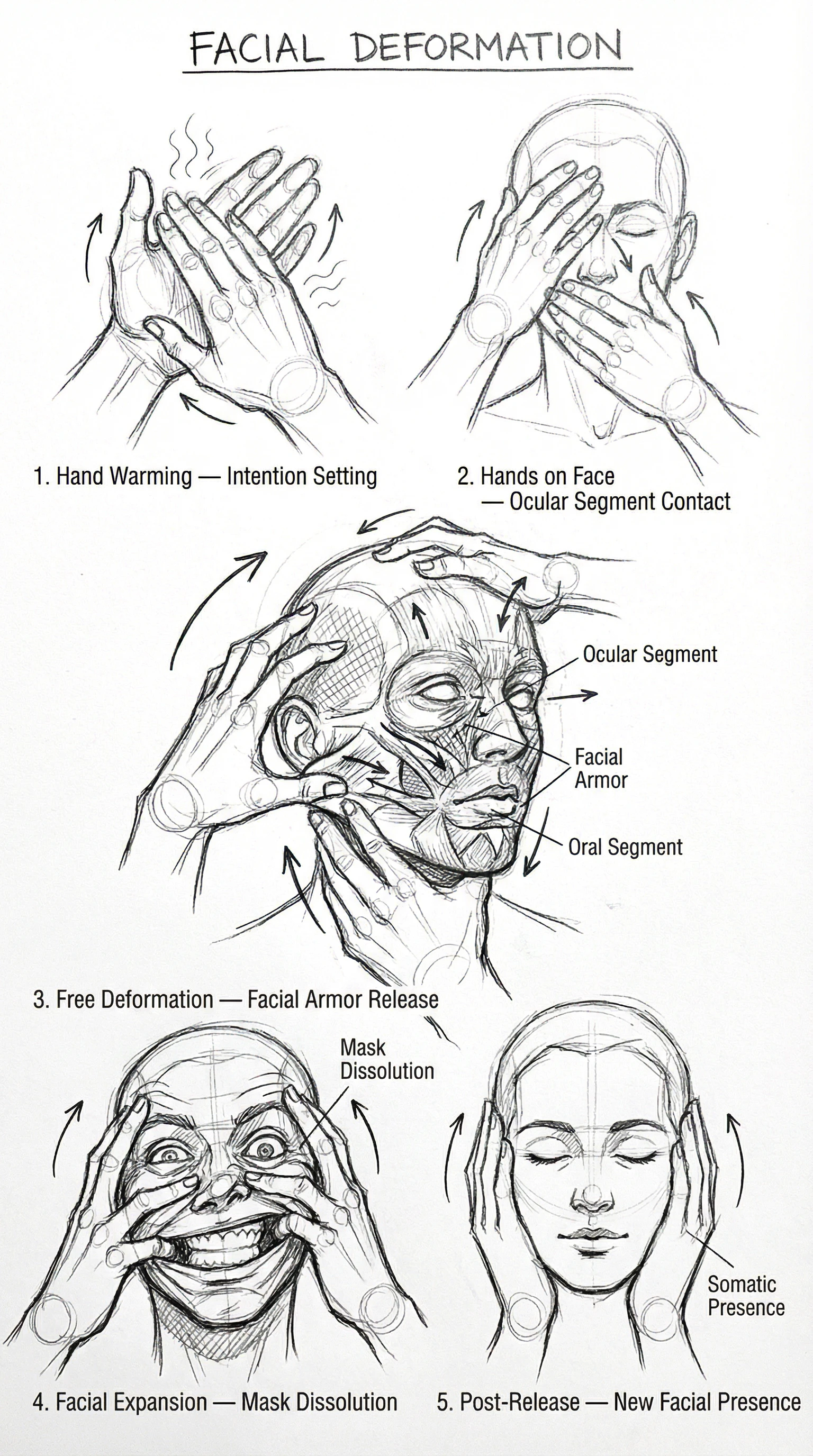
Warm your hands by rubbing them together — you may set an intention as you do so. Bring your hands to your face and manipulate it intuitively. Do this freely, without fear of transforming. Use and explore all the movements your face needs. Open and expand your face.
Use it when
when you need to dissolve habitual ways of thinking, seeing, feeling, and showing yourself to others, and break repetitive patterns
What it is for
change your face, your mask, your gaze, your felt sense — open yourself and prepare for the new
Centring
Mental Support Hold
“I can rebalance my mental space”
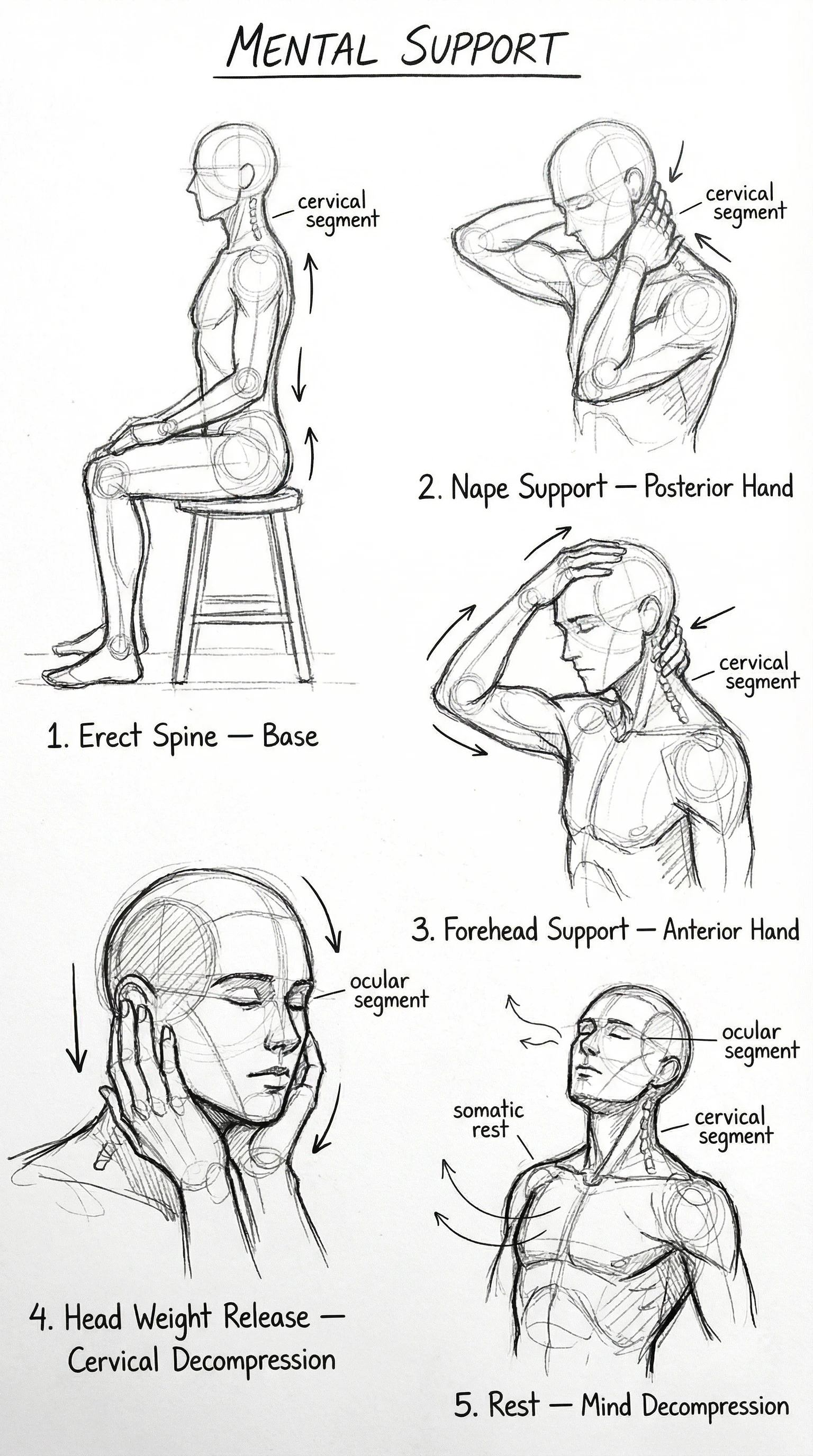
Keep the spine erect. Place one hand on the back of the neck, cradling it firmly so you feel a solid hold. Place the other hand on the forehead and apply gentle pressure so your head feels supported enough to release its weight into both hands. The goal is to let the head rest — you are creating a support both behind and in front of it. Breathe and settle in.
Use it when
when you need to soothe and quiet the mind
What it is for
quiet the mind, rest, relax, release thoughts, allow the weight to yield, depressurize the head
Where this comes from
Reich's ocular segment, read through Boadella's view of movement as emotional process rather than exercise.
Body Anchor’s method is inspired by four foundational thinkers in
body-based psychotherapy. Their work is the lineage every sequence on this
site sits in.
Wilhelm Reich — Character analysis and the concept of muscular armor.
Alexander Lowen — Bioenergetic analysis and grounding-based bodywork.
David Boadella — Biosynthesis approach connecting movement and emotional process.
Gerda Boyesen — Biodynamic psychology and gentle somatic release work.
Questions people ask
Why does reasoning with anxiety make it worse?
Because you are feeding the same machine. The loop feels mental, but underneath it a body is braced, usually around the eyes, forehead and the back of the neck. While the bracing continues, the mind keeps getting the signal that something is unresolved.
How long does this take?
Three exercises, a few minutes. It is shorter than the other guides on purpose.
Anxiety was one answer. What is yours?
The app asks what you feel and where you feel it, then builds the protocol for that exact pair. 218 exercises, three to ten minutes.