Four exercises, about five minutes. For when fear has pulled you up out of your own legs.
4 exercises · about 5 minutes · nothing to buy, nothing to install
Short answer
Breathing helps but it comes second. Fear pulls your weight up and out of your legs. What changes the state is getting weight back into the floor, which body therapists call grounding, so the body stops organising itself around escape.
Fear lives in your legs, not your head
Watch someone frightened and you will see it before they say anything. The weight comes up. Shoulders rise, breath goes high and small, knees lock, and the whole body organises itself around getting away.
This is useful if there is something to run from. Most of the time now there is not, so you are left standing in a kitchen with a body ready to sprint and nowhere to sprint to.
Everyone tells you to breathe. Breathing helps, but it is second. What actually changes the state is weight: getting your legs to hold you again, feeling the floor push back. Body therapists call it grounding, and it is not a metaphor. It is where your mass is.
The exercises below work from the floor up. If you can do them standing, do them standing.
The exercises
Do them in this order and go slowly. If something feels like too much, stop and
breathe. That is part of the practice, not fine print.
Perception
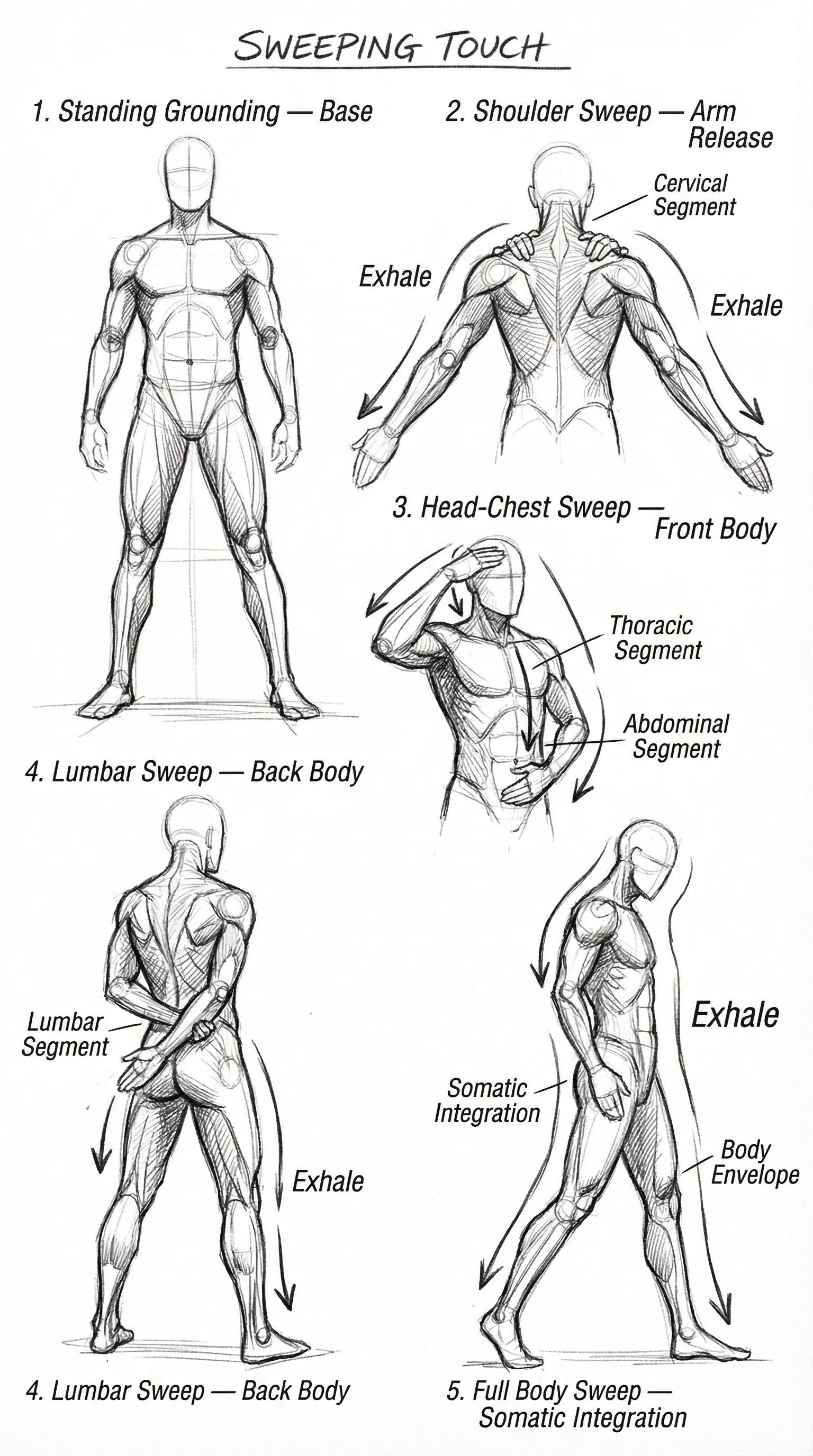
Enveloping Touch
“I can feel safe in my wholeness”
Slide your hands along your entire body as though enveloping yourself — acknowledging your skin or creating a thin film wherever you touch. You can also imagine that you are 'painting' each part of the body as you place your hand on it. Wherever you sense a need, repeat the touch several times until that area feels fully enveloped. Move from feet to head. Breathe with each movement, without rushing.
Use it when
when you need to bring safety, comfort, and presence to yourself
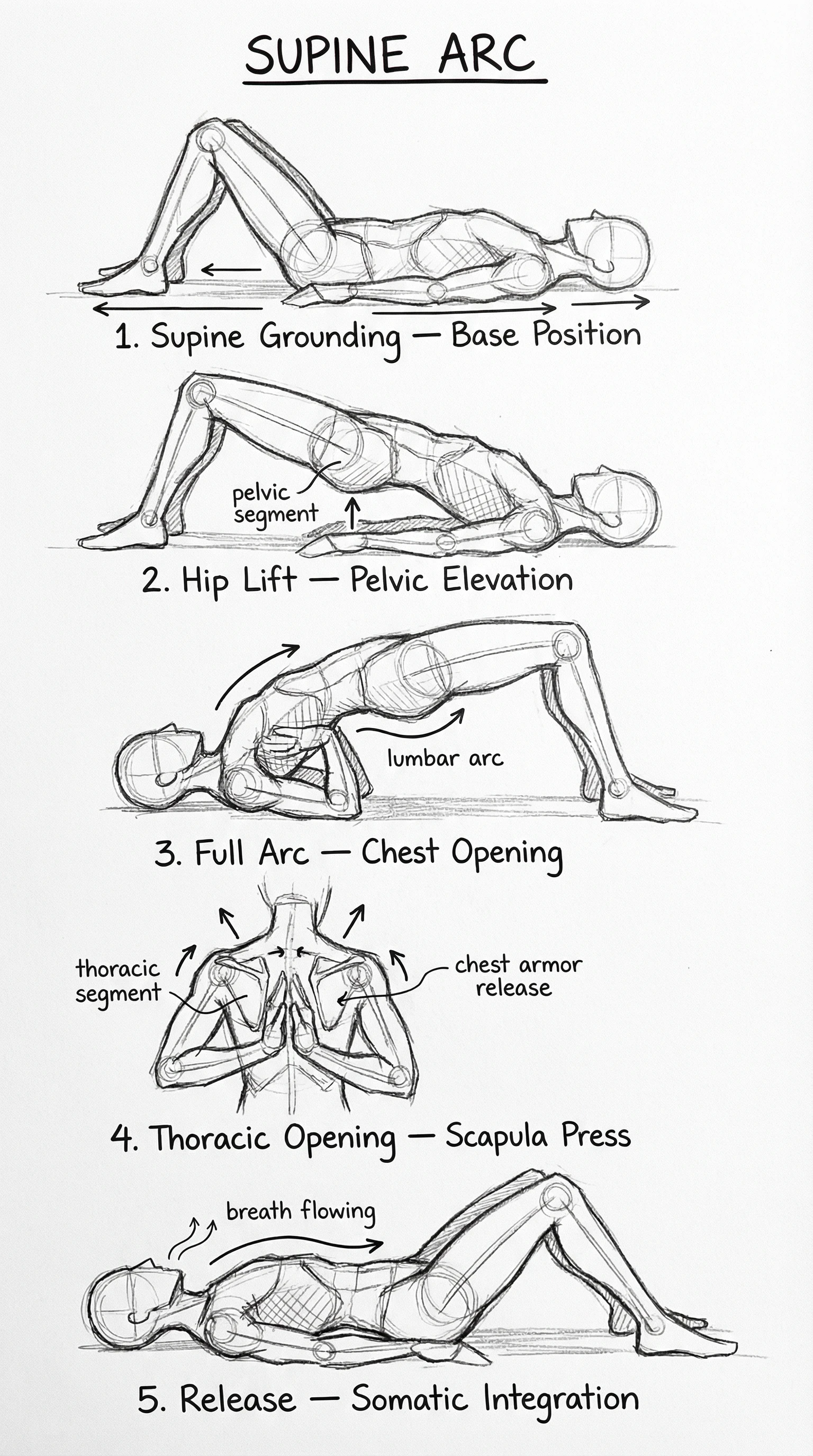
“I can expand my flow of sensations and feelings safely”
Lie in lying grounding (previous posture), then lift your pelvis as high as possible, creating a bow arch with your body. Place your hands behind you for support and find the best opening in the abdominal region. Breathe and hold the position as long as comfortable. Return to lying grounding and relax.
Use it when
when you want to expand your breathing and aliveness
What it is for
expand breathing, energetic streaming, and bodily aliveness
Straight at it
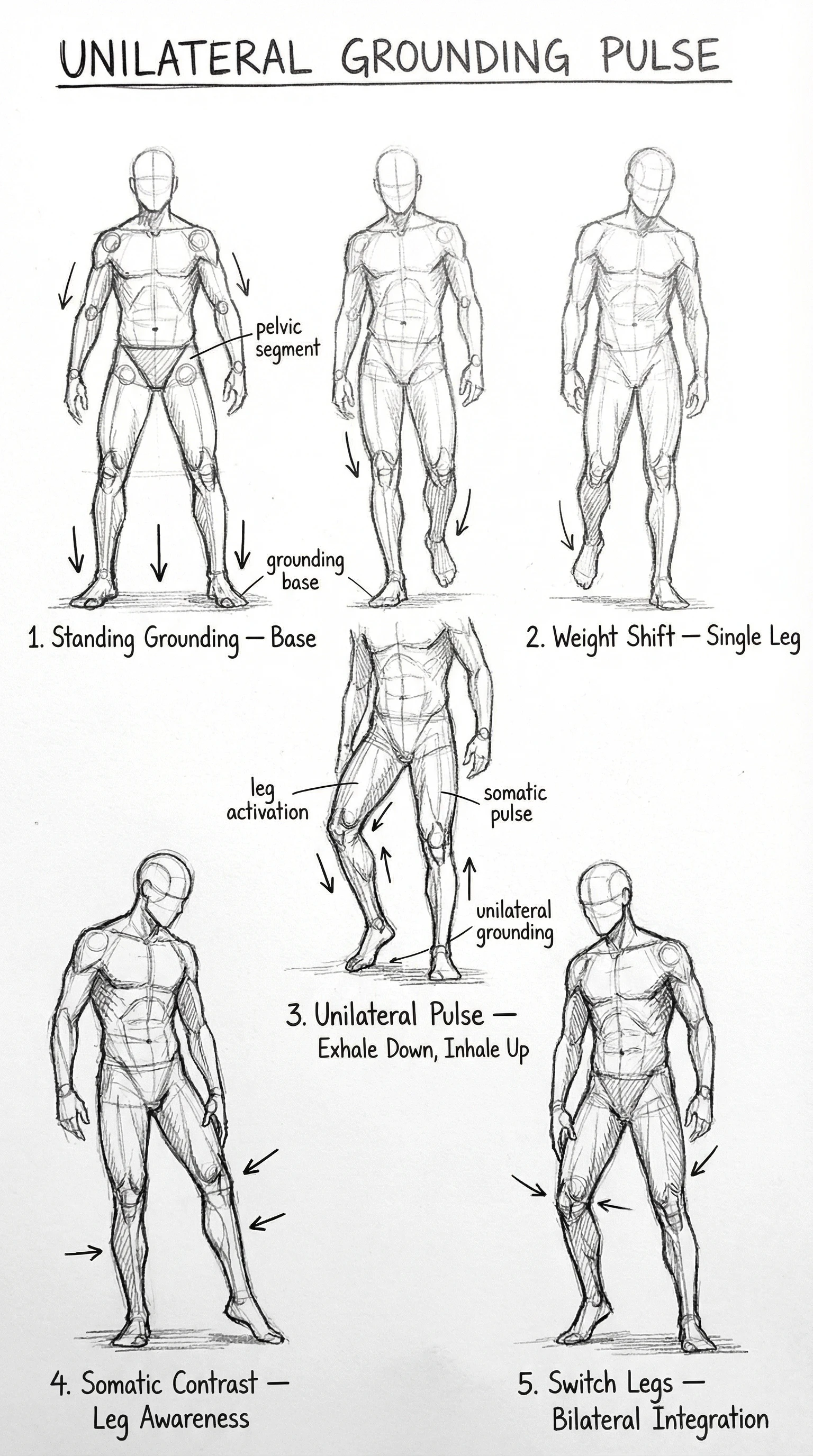
Unilateral Grounding Pulsation
“I can balance the ways I express myself”
Position yourself in standing grounding with knees bent and feet parallel. Shift your core axis onto the leg that remains planted. Once in balance, begin to pulse that leg — descending rhythmically and with focus, feeling your core axis. On the rise, release the tension. When you stop, notice the difference in balance between one leg and the other. Then perform the same exercise on the other leg.
Use it when
when you need to equalize the polarities of your functioning
What it is for
redistribute your body weight; compensate for imbalances and overloads; balance polarities — feeling and reason, passivity and action, feminine and masculine
Centring
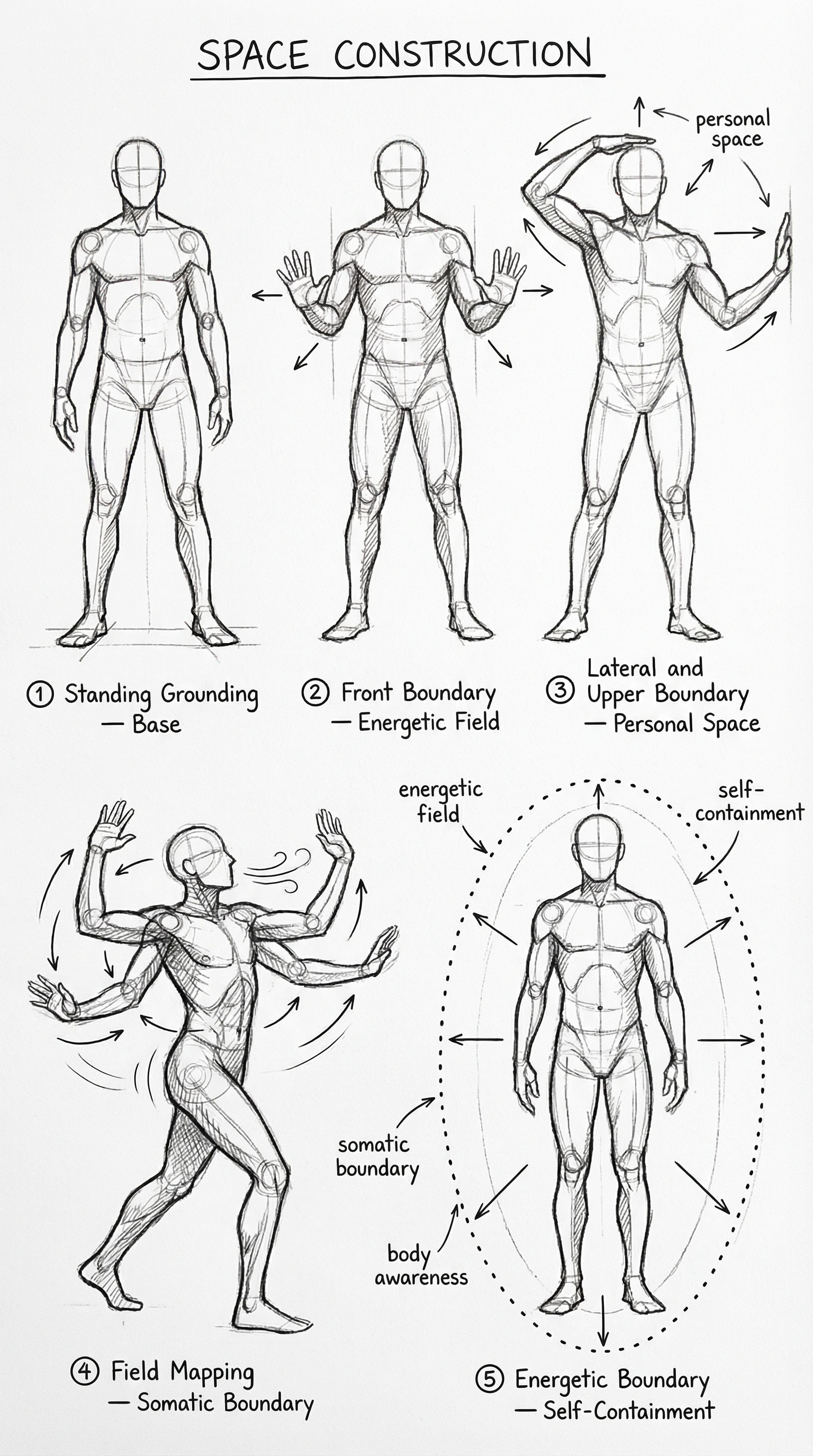
Space Building
“the space around me is mine”
In grounding, touch the space around you with open palms; you can explore energetic walls or physical walls — in front, behind, above, below, to the sides — using rhythmic, exploratory, creative, or patterned movements. The most important thing is to feel the movement, become aware of the space, take ownership of it, and create and visualize the boundaries of your body and the bioenergetic field surrounding you. Always keep the body in a soft bend and allow the breath to flow together with the movement.
Use it when
when you need to reclaim your personal space
What it is for
recognize that the space around you belongs to you; develop awareness of limits, boundaries, personal space, and energetic protection
Where this comes from
Grounding is Lowen's term and Lowen's contribution. Weight into the legs before anything is asked of the breath.
Body Anchor’s method is inspired by four foundational thinkers in
body-based psychotherapy. Their work is the lineage every sequence on this
site sits in.
Wilhelm Reich — Character analysis and the concept of muscular armor.
Alexander Lowen — Bioenergetic analysis and grounding-based bodywork.
David Boadella — Biosynthesis approach connecting movement and emotional process.
Gerda Boyesen — Biodynamic psychology and gentle somatic release work.
Questions people ask
Why does breathing alone not stop panic?
Breathing helps but it comes second. Fear pulls your weight up and out of your legs. What changes the state is getting weight back into the floor, which body therapists call grounding, so the body stops organising itself around escape.
Should I do these standing up?
Yes, if you can. They work from the floor up and the legs are the whole point.
Fear was one answer. What is yours?
The app asks what you feel and where you feel it, then builds the protocol for that exact pair. 218 exercises, three to ten minutes.