Four exercises, about five minutes. For being tired in a way that sleeping does not fix.
4 exercises · about 5 minutes · nothing to buy, nothing to install
Short answer
Holding costs energy. If parts of you have been braced for weeks, that bracing runs all night and you wake having done a shift you did not agree to. The tiredness is real and it is not about sleep.
Tired after eight hours of sleep
You slept. You slept properly, the whole night, and you woke up as tired as you went to bed. So you assume you need more sleep, and more sleep does not touch it either.
Holding costs energy. If parts of you have been braced for weeks, that bracing runs all night, and you wake up having done a shift you did not agree to. The tiredness is real and it is not about sleep.
There is a trap here. When you are this flat, hard exercise sounds like the answer and usually makes it worse. What helps is smaller: movements that get circulation and breath going without asking you to push.
Start slower than you think you need to. If you feel a bit more alive halfway through, that is the thing working.
The exercises
Do them in this order and go slowly. If something feels like too much, stop and
breathe. That is part of the practice, not fine print.
Perception
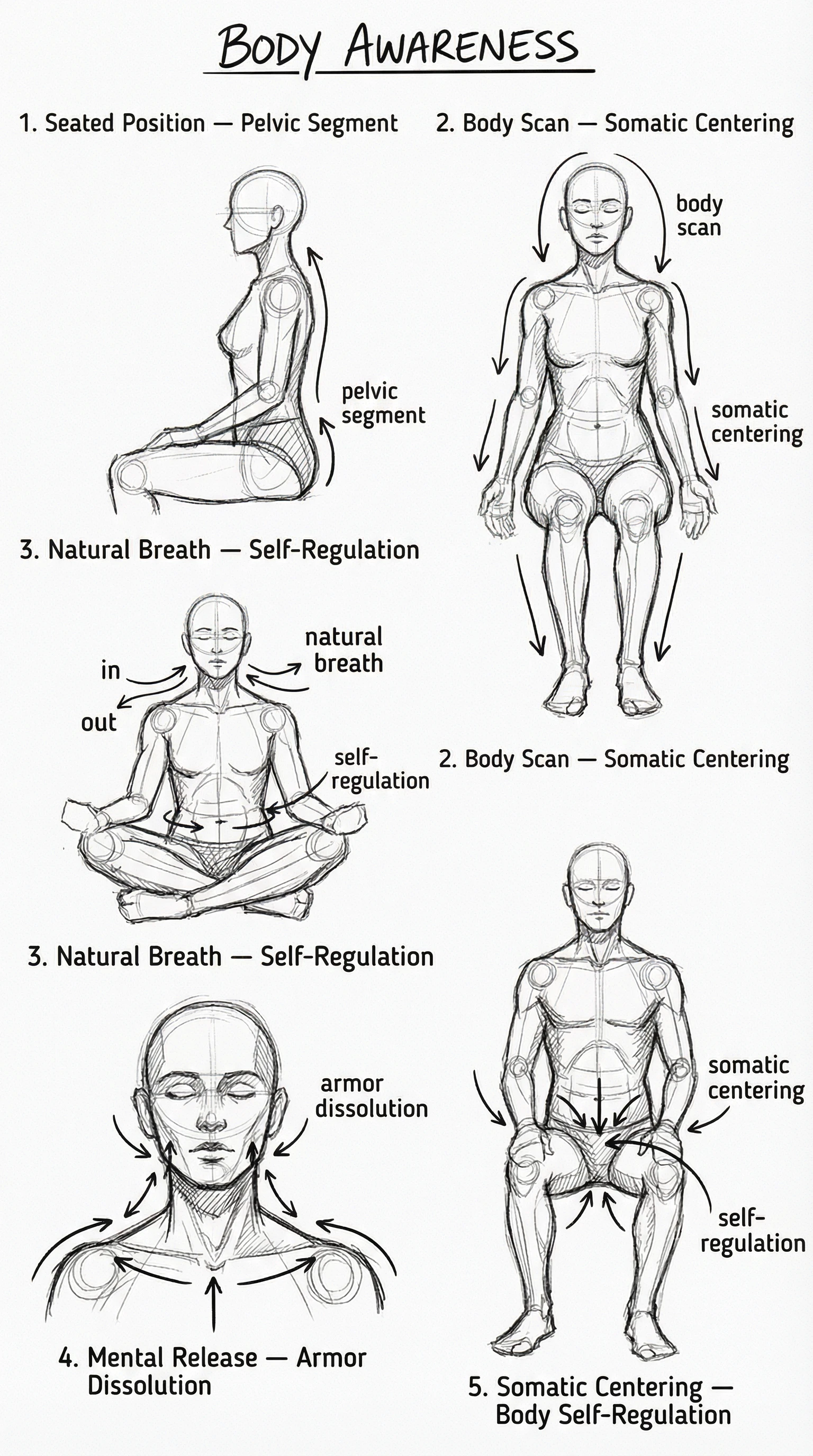
Self-Awareness
“everything is here”
Position yourself comfortably. Keep the spine upright with minimal effort. Breathe naturally. Release perceived tensions through gentle mental intention, allowing self-regulation to arise organically.
Use it when
when you want to perceive and centrate yourself
What it is for
perceive yourself; allow the body to self-regulate through awareness and breath
Working around it
Jaw Breathing
“I can let go”
Find a comfortable position. Keep your spine aligned with minimal effort. Inhale calmly and deeply, then release the breath on the exhale with your mouth opened as wide as possible. Let the deep, warm air leave your body naturally — usually accompanied by a sound ('aah') and a soft exhale. Repeat, growing more comfortable with the movement each time. Feel your heart depressurizing. Take pauses, return to your center, and re-align your spine.
Use it when
when you want to amplify your energetic, emotional, or mental discharge in a simple and fast way
What it is for
relieve excess energetic charge, and stagnant thoughts and emotions held in the body
Straight at it
Voluntary Shaking
“I can open pathways within myself and change my inner reality”
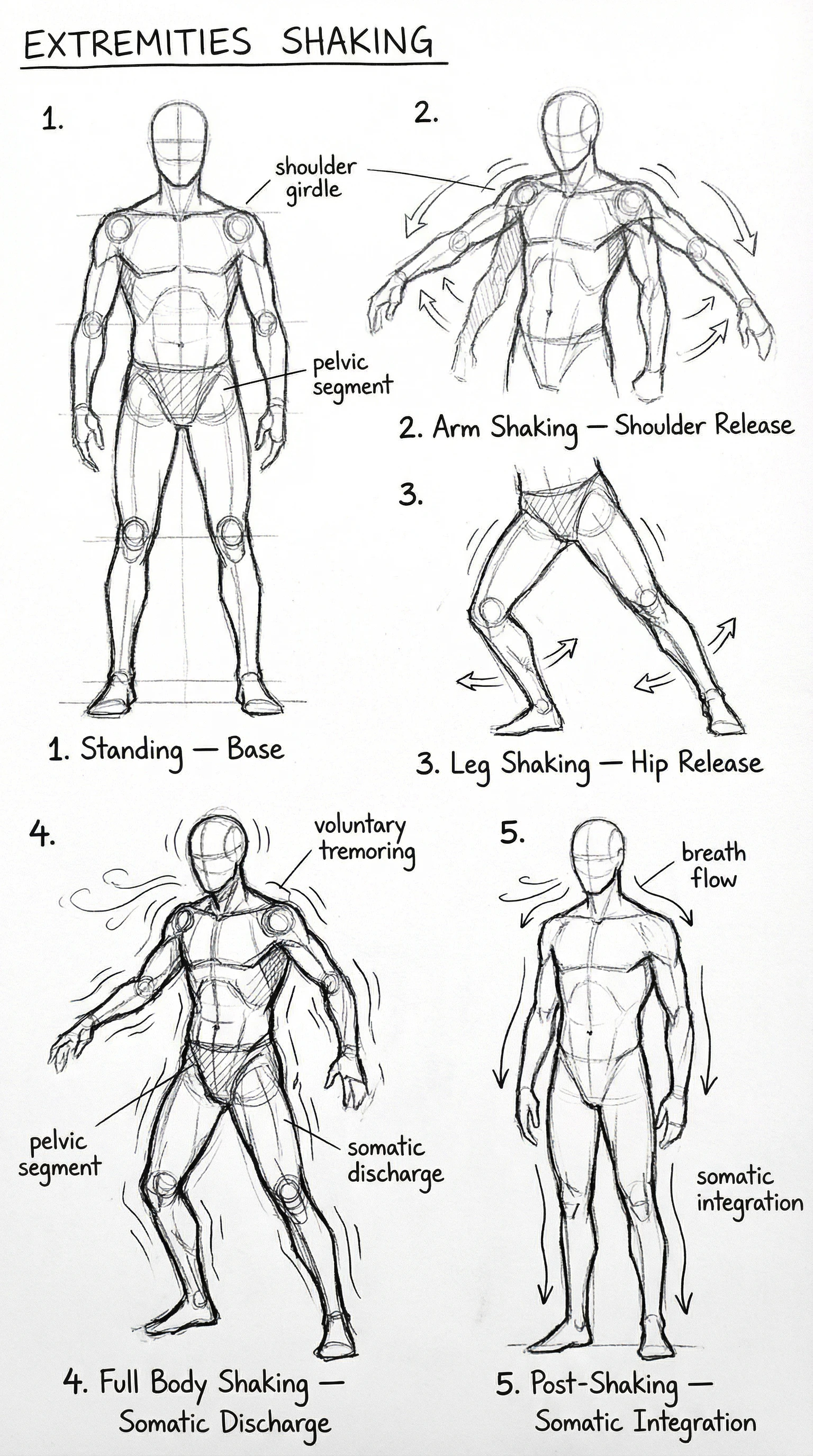
Plant all your body weight firmly through the legs and feet; allow the shaking to arise from the movement of the legs pushing down into the floor, which sends a vibratory response upward through the body; release the jaw, shoulders, belly, and pelvic floor; let the body sway freely; keep the breath loose and through the mouth.
Use it when
when you need to activate the body's energy streaming
What it is for
release bodily movements and tensions, activate aliveness, allow sensations to stream freely, bring awareness to the legs
Centring
Lying Relaxation
“I surrender to my body”
Release the full weight of your body into the floor, allowing gravity to settle over you. Relax your head, shoulders, mouth, tongue, and jaw; let your arms and legs fall to the sides. Allow the breath to stream naturally through your chest and belly. To deepen the relaxation, gently lengthen and soften the exhale. Focus your mental attention on the sensations produced by the breath.
Use it when
when you need to rest and accommodate intensities
What it is for
allow your body to self-regulate and reorganize naturally
Where this comes from
Boyesen's biodynamic psychology, which treats low energy as energy being held rather than energy that is missing.
Body Anchor’s method is inspired by four foundational thinkers in
body-based psychotherapy. Their work is the lineage every sequence on this
site sits in.
Wilhelm Reich — Character analysis and the concept of muscular armor.
Alexander Lowen — Bioenergetic analysis and grounding-based bodywork.
David Boadella — Biosynthesis approach connecting movement and emotional process.
Gerda Boyesen — Biodynamic psychology and gentle somatic release work.
Questions people ask
Why am I tired after eight hours of sleep?
Holding costs energy. If parts of you have been braced for weeks, that bracing runs all night and you wake having done a shift you did not agree to. The tiredness is real and it is not about sleep.
Should I exercise harder instead?
Usually not. When you are this flat, hard exercise tends to make it worse. Small movements that get circulation and breath going work better.
Exhaustion was one answer. What is yours?
The app asks what you feel and where you feel it, then builds the protocol for that exact pair. 218 exercises, three to ten minutes.