Four exercises, about five minutes. For a chest that feels closed and will not open on request.
4 exercises · about 5 minutes · nothing to buy, nothing to install
Short answer
Get it looked at first if you have not. This guide is for tightness that has already been medically cleared and is still there every evening, which is very common.
A tight chest that the doctor could not explain
First, the boring but necessary part: if your chest is tight and you have not had it looked at, have it looked at. This page is not for chest pain of unknown origin.
Assume you have. Assume everything came back clear and the tightness is still there every evening. That is extremely common and it has a shape.
The chest is where you hold what you did not let out. Not one thing, usually. Years of small ones. The ribs stop moving as much as they could, the breath gets shallow at the top, and it settles into a feeling of being closed that you stop noticing until someone points it out.
Opening it is not about forcing the ribs apart. It is about giving the chest a reason to move again, which the sequence below does gradually rather than all at once.
The exercises
Do them in this order and go slowly. If something feels like too much, stop and
breathe. That is part of the practice, not fine print.
Perception
Self-Awareness
“everything is here”
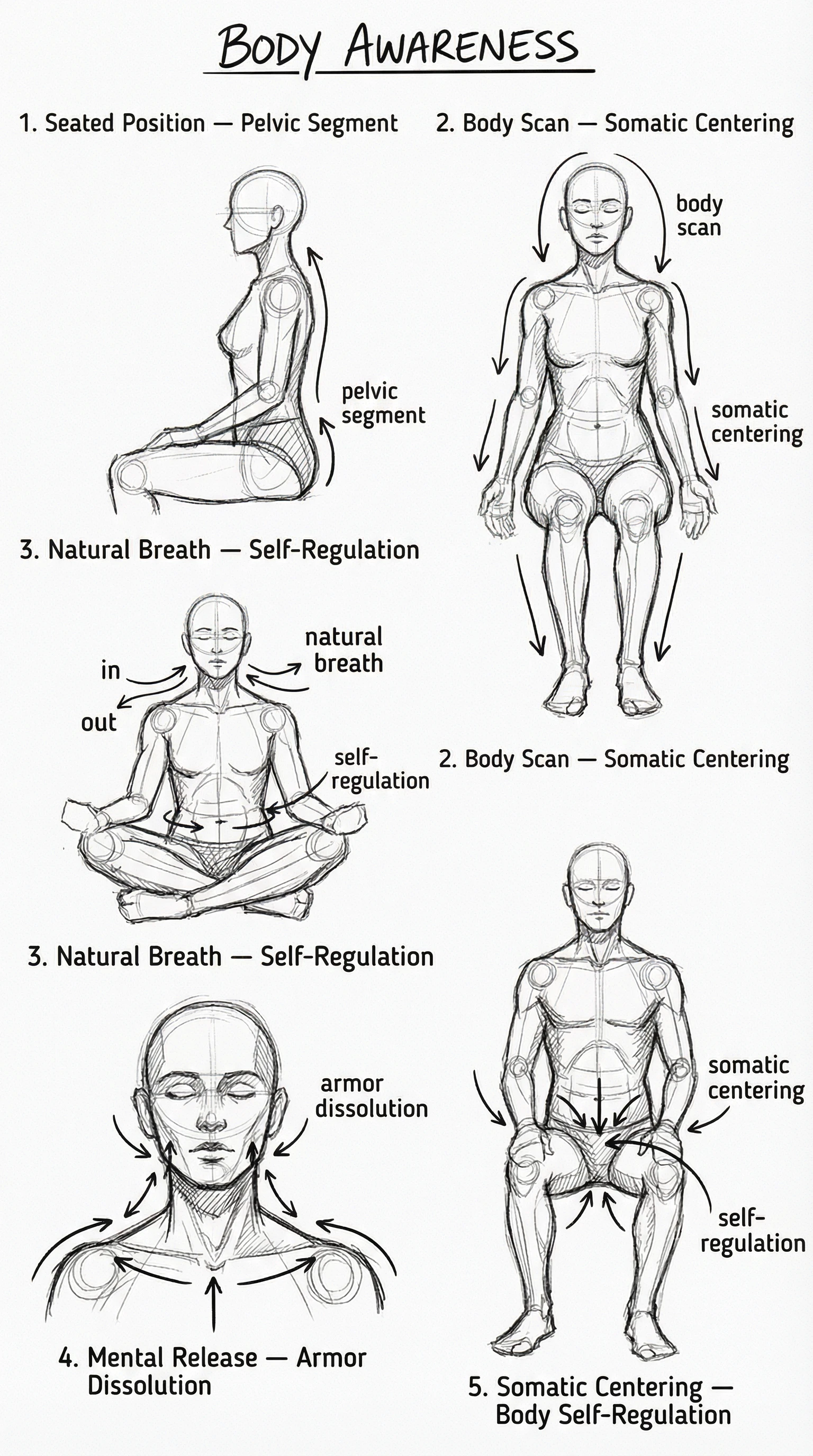
Position yourself comfortably. Keep the spine upright with minimal effort. Breathe naturally. Release perceived tensions through gentle mental intention, allowing self-regulation to arise organically.
Use it when
when you want to perceive and centrate yourself
What it is for
perceive yourself; allow the body to self-regulate through awareness and breath
Working around it
Lateral Weight Shift
“I can re-establish the place where I find balance; I can reclaim the place where I feel alive”
Standing with knees slightly bent, perform a lateral sway — shifting your body weight to the left and then to the right, in a rhythmic back-and-forth motion. Let the full weight of your body settle into the outer, front, and back edges of one foot and the inner edge of the other, as if everything is 'weighing' to the same side (see image a). Breathe throughout, especially as you release your body weight into the edges of the foot.
Use it when
when you need to soften the way you are holding yourself in your body and in life
What it is for
balance the body's weight distribution, align the more overloaded side, establish contact with the legs, ground into the feet, develop balance and a sense of center
Straight at it
Thymus and Chest Activation
“I can be alive and open in my feelings”
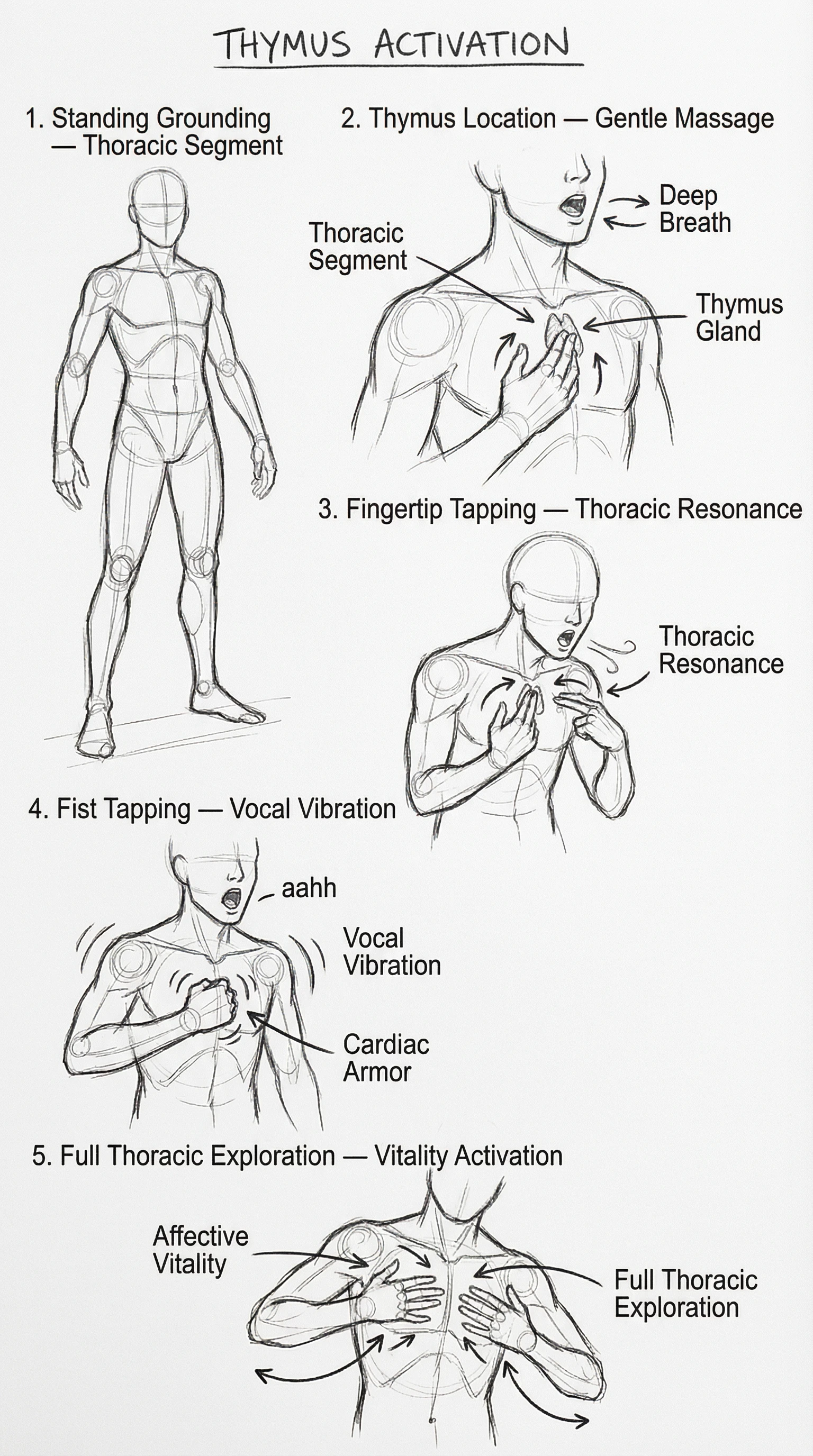
Touch the thymus region (located about 2 to 3 fingers below the collarbone, along the body's central line). Massage it and breathe deeply, releasing the air through your mouth. Begin tapping with your fingertips, then progress to tapping with a semi-closed hand (see auxiliary images). Allow the air to flow out freely. Continue the tapping. If possible, let out the sound 'aaahh', allowing your voice to vibrate alongside the tapping on the chest. Explore this tapping across the entire chest area, wherever the movement feels accessible. Let your chest and voice resonate together.
Use it when
when you want to awaken the affective potential of the chest
What it is for
activate the chest and expand the capacity of the thoracic armored segment
Centring
Fetal Position
“I can always access my nest”
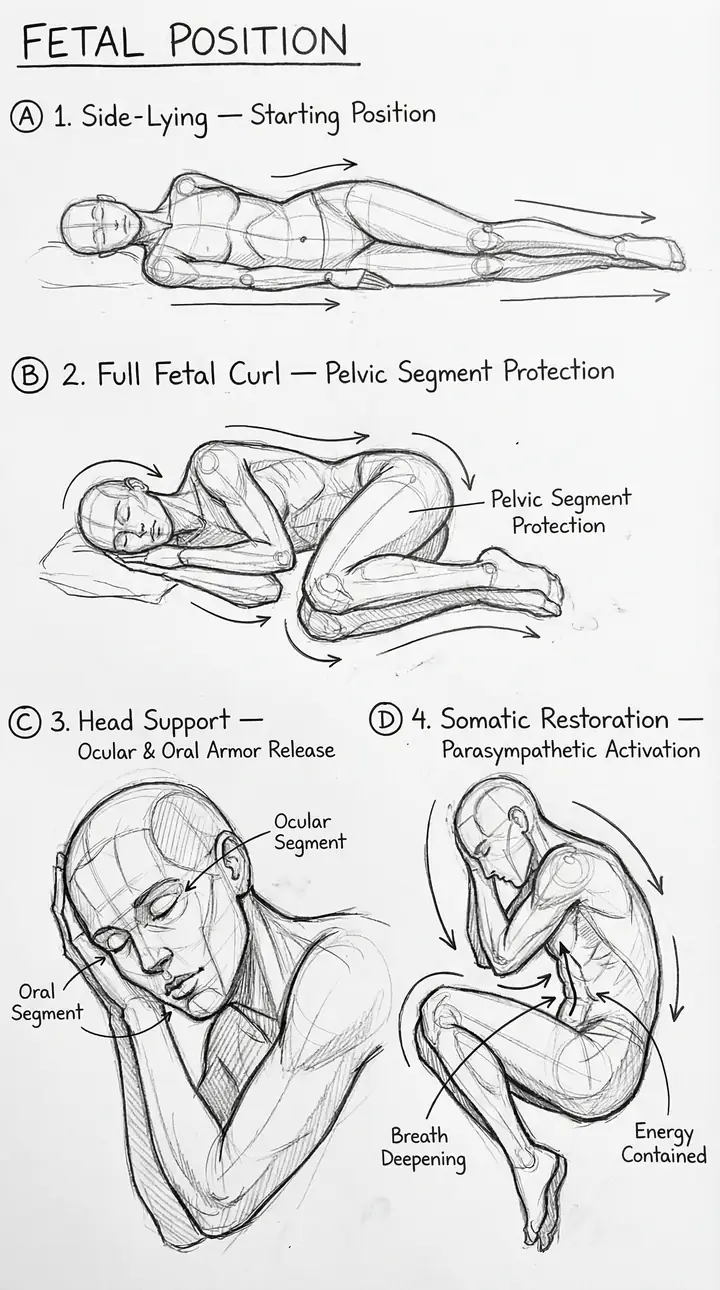
Lie comfortably on your side with legs drawn in and your trunk slightly curled toward your legs (fetal position). Use your arms to support your head in whatever way feels most comfortable, or adjust other body parts as needed — shoulders, face. Breathe deeply and rest in this place.
Use it when
when it is necessary to enter a highly protected and nurturing space
What it is for
to restore, momentarily close off from the world, pause, recover strength, and protect yourself
Where this comes from
The thoracic segment, fourth of Reich's seven rings, worked gradually in the way Boadella's biosynthesis describes.
Body Anchor’s method is inspired by four foundational thinkers in
body-based psychotherapy. Their work is the lineage every sequence on this
site sits in.
Wilhelm Reich — Character analysis and the concept of muscular armor.
Alexander Lowen — Bioenergetic analysis and grounding-based bodywork.
David Boadella — Biosynthesis approach connecting movement and emotional process.
Gerda Boyesen — Biodynamic psychology and gentle somatic release work.
Questions people ask
Should I worry about a tight chest?
Get it looked at first if you have not. This guide is for tightness that has already been medically cleared and is still there every evening, which is very common.
Why does my chest feel closed?
The chest holds what was not let out, usually years of small things rather than one event. The ribs stop moving as much as they could and the breath settles high and shallow.
Your chest was one answer. What is yours?
The app asks what you feel and where you feel it, then builds the protocol for that exact pair. 218 exercises, three to ten minutes.