Four exercises, about five minutes. For the band across your forehead that nothing seems to reach.
4 exercises · about 5 minutes · nothing to buy, nothing to install
Short answer
Screens do not help, but the eyes are also where the body does its watching, and watching is what you do when some part of you is not sure it is safe. What you get is a braced forehead and a face holding an expression it never chose.
The screen gets blamed for this, and it is only half true
By six in the evening there is a band across your forehead and a dull ache behind your eyes. You assume it is the monitor.
Screens do not help. But the eyes are also where the body does its watching, and watching is what you do when some part of you is not sure it is safe. Braced eyes, tight forehead, and a face that has been holding an expression it never chose.
This is the region body psychotherapy calls the ocular segment: eyes, forehead, temples, the base of the skull. It is the first place many people armour and the last place they think to look.
The exercises below are small and quiet. There is nothing strenuous here. Dim the light if you can.
The exercises
Do them in this order and go slowly. If something feels like too much, stop and
breathe. That is part of the practice, not fine print.
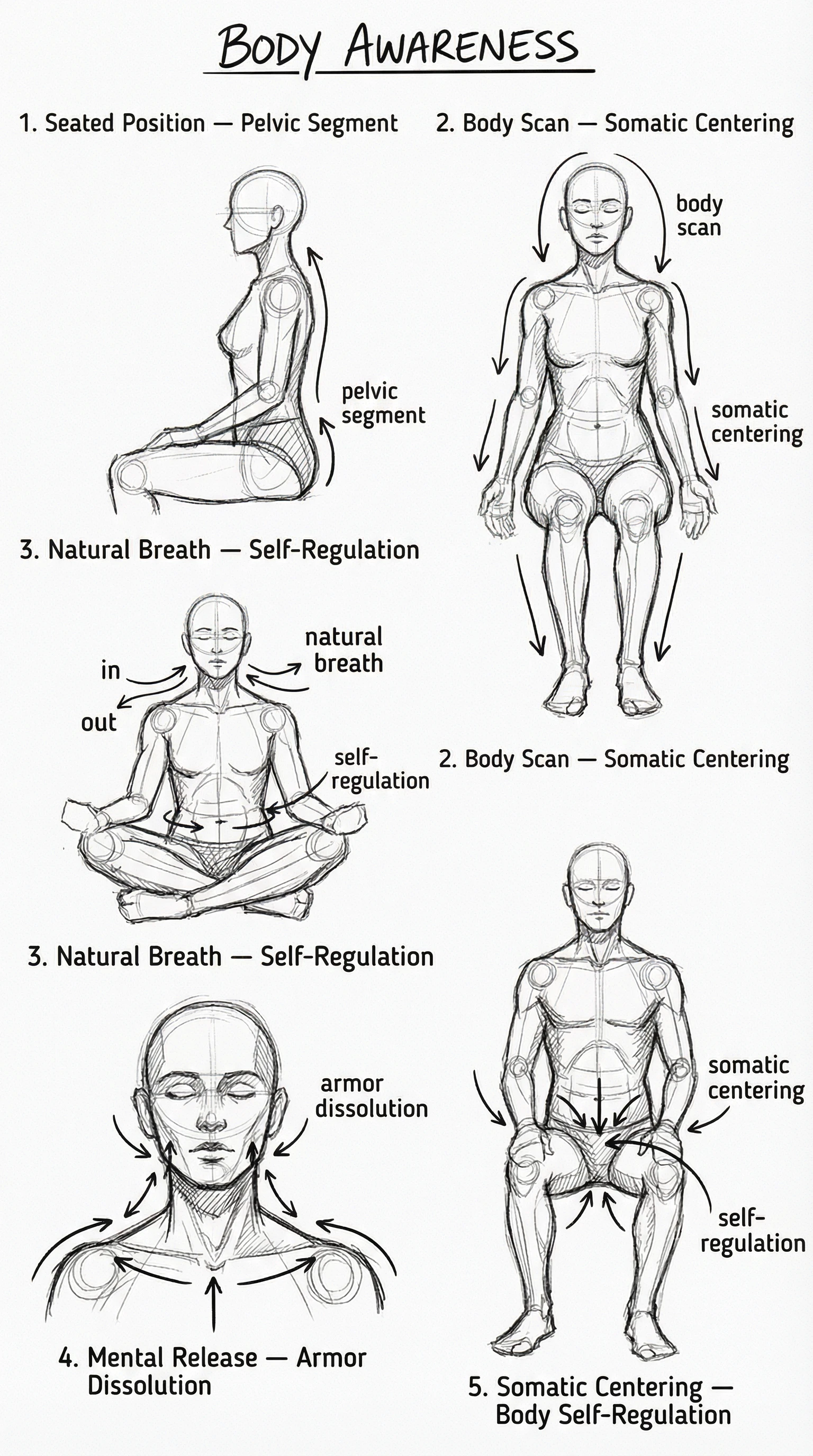
Perception
Self-Awareness
“everything is here”
Position yourself comfortably. Keep the spine upright with minimal effort. Breathe naturally. Release perceived tensions through gentle mental intention, allowing self-regulation to arise organically.
Use it when
when you want to perceive and centrate yourself
What it is for
perceive yourself; allow the body to self-regulate through awareness and breath
Working around it
Broom on the Nape
“I can open new spaces in my mind”
Keep the spine upright and position a broom handle at the base of the skull. Press upward from below. You may slide, press, and rotate the handle according to your intuition and needs. Always exhale as you press, and inhale as you ease the pressure. The head movement is free and can help deepen the connection with the mouth and jaw. If it hurts, simply breathe into it. Remember to apply these touches without excess — gently and respectfully, in tune with the process. Preferably do this standing, though it is not required. When you finish, look around your whole environment.
Use it when
when you want to release excess mental tension
What it is for
to mobilize accumulated mental-emotional armoring in the cervical region
Straight at it
Eyelid Touch
“I can ease and welcome my gaze”
Close your eyes and place your fingers gently on your closed eyelids — lightly, without pressure. Breathe and notice the effects of this touch. Let your head tilt slightly forward to make the touch more comfortable, and relax your shoulders throughout the experience.
Use it when
when you need to soften and quiet mental activity
What it is for
to soften eye tension, reduce stimulation, and welcome the self
Centring
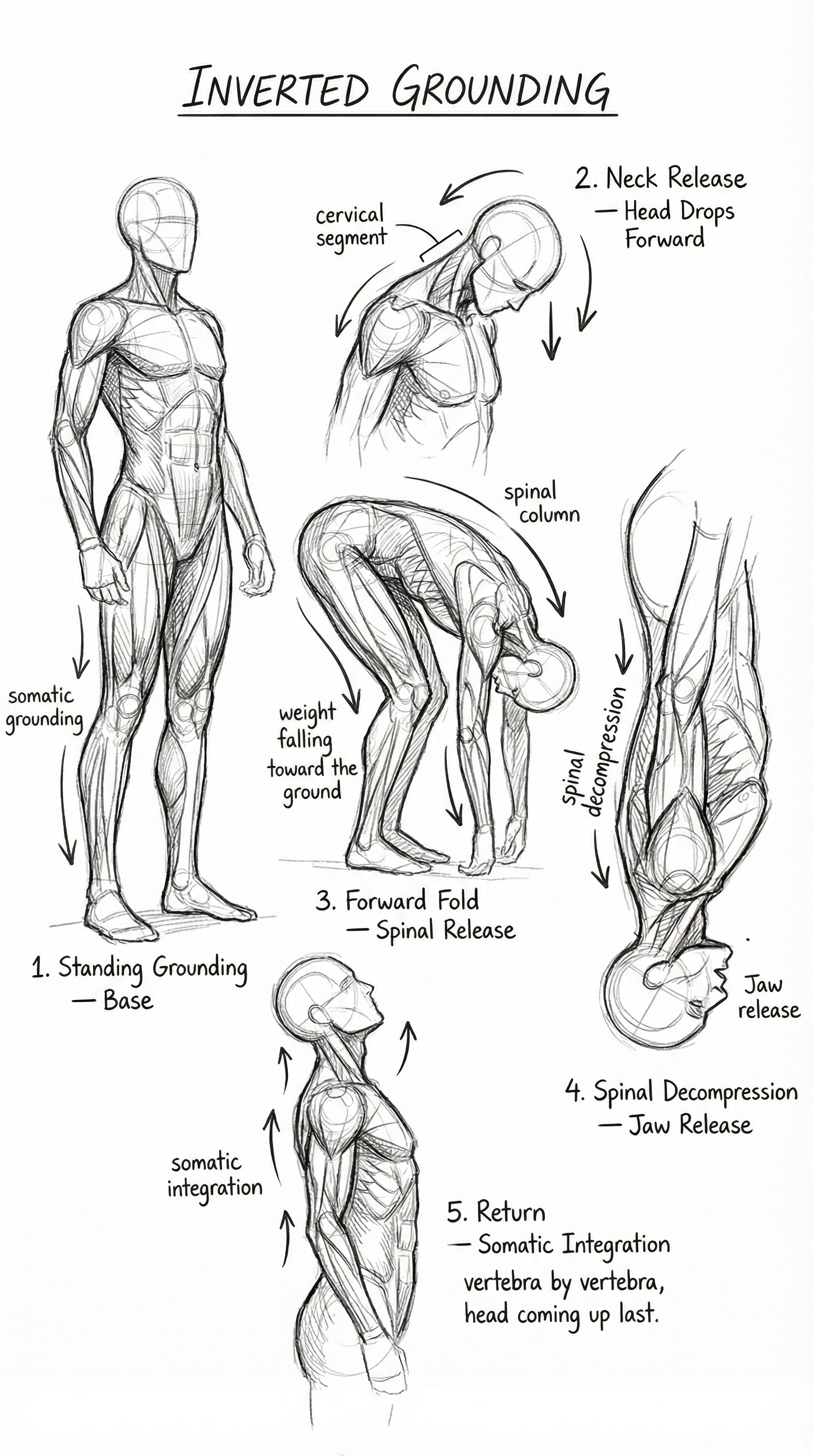
Inverted Grounding
“inversion of hierarchy: your aliveness (pelvis) is above your emotions (heart) and thoughts (head)”
Root the full weight of your body into your legs and feet. Relax your neck and let the top of your head move toward the floor. Release the weight of your spine so your torso can draw close to your legs. Breathe deeply. Let your jaw release.
Use it when
when full-body rebalancing is needed
What it is for
deepen contact with yourself, reorganize your being, yield, integrate, rest the spine and head, draw closer to your vital force, support mental reorganization and emotional settling
Where this comes from
The ocular segment is the first of the seven rings of muscular armor Reich described.
Body Anchor’s method is inspired by four foundational thinkers in
body-based psychotherapy. Their work is the lineage every sequence on this
site sits in.
Wilhelm Reich — Character analysis and the concept of muscular armor.
Alexander Lowen — Bioenergetic analysis and grounding-based bodywork.
David Boadella — Biosynthesis approach connecting movement and emotional process.
Gerda Boyesen — Biodynamic psychology and gentle somatic release work.
Questions people ask
Is forehead tension just screen time?
Screens do not help, but the eyes are also where the body does its watching, and watching is what you do when some part of you is not sure it is safe. What you get is a braced forehead and a face holding an expression it never chose.
What is the ocular segment?
The name body psychotherapy gives to the eyes, forehead, temples and base of the skull treated as one region of holding. It is often the first place people armour and the last place they think to look.
Your eyes were one answer. What is yours?
The app asks what you feel and where you feel it, then builds the protocol for that exact pair. 218 exercises, three to ten minutes.