Four exercises, about five minutes. They come out of body psychotherapy, and the order they go in matters more than you would guess.
4 exercises · about 5 minutes · nothing to buy, nothing to install
Short answer
The jaw is where the body parks an impulse it decided not to release: something unsaid, anger swallowed, a cry stopped halfway. A pattern built out of holding in does not answer to being told to let go. It answers to being allowed to move.
Why “just relax your jaw” never works
Someone tells you to relax your jaw. You do it. It holds for about four seconds and then you are clenching again.
That is not a discipline problem. The jaw is one of the places the body parks things it decided not to let out. Something you did not say. Anger you swallowed. A cry you stopped halfway. The muscle braces to hold it there, and then it goes on bracing long after you have forgotten what started it.
Body psychotherapy calls this area the oral segment. It is bigger than the jaw itself: mouth, chin, throat, the base of the tongue, all one piece of holding.
Which brings up the thing that actually changes what you do next. A pattern built out of holding in does not answer to being told to let go. It answers to being allowed to move.
So the sequence below does not start at your jaw. It starts with noticing. Then it goes at the jaw directly. Then it leaves the area completely. Then it brings you back and settles you. That is how a body therapist runs it, and it is the same order our engine uses when someone opens the app and says their jaw is locked.
The exercises
Do them in this order and go slowly. If something feels like too much, stop and
breathe. That is part of the practice, not fine print.
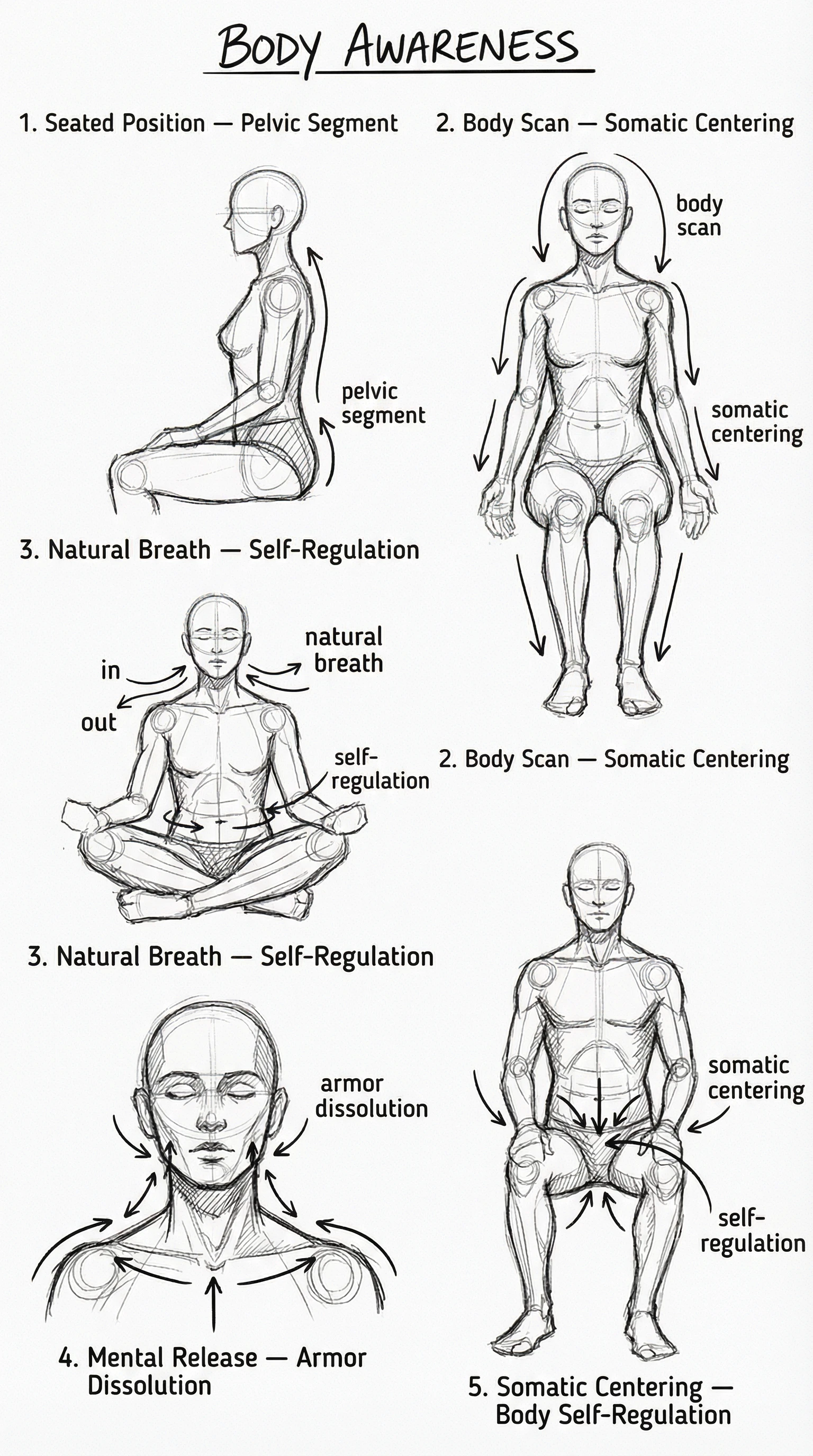
Perception
Self-Awareness
“everything is here”
Position yourself comfortably. Keep the spine upright with minimal effort. Breathe naturally. Release perceived tensions through gentle mental intention, allowing self-regulation to arise organically.
Use it when
when you want to perceive and centrate yourself
What it is for
perceive yourself; allow the body to self-regulate through awareness and breath
Straight at the jaw
Dropped Jaw Release
“I can let my jaw drop”
Grasp your jaw, pressing the index finger against the thumb, and massage the entire region. This movement can extend along the full edge of the jawline, on both the left and right sides. Whenever you press your fingers in, release the breath. When you ease your grip, inhale.
Use it when
when you want to allow yourself to feel your emotions and vulnerabilities more fully
What it is for
release tension in the jaw armored segment; loosen the holding pattern that keeps you braced against everything; allow yourself to yield in safety
Away from the jaw
Wall Back Massage
“I can transform tension into pleasure”
Lean your back against a wall, bend your knees and plant your feet on the floor so they form roughly a 90° angle. Using the strength of your back, slide up and down against the wall. Make full use of hip and upper back movements to explore. Your knees will move and you may need to peel parts of your back away from the wall at certain moments. Always move in resonance with your breath. Relax and seek pleasure.
Use it when
when you need to relax without losing structure and support
What it is for
to activate tension throughout the entire back, relax the body, activate and integrate the legs, play, and explore
Centring
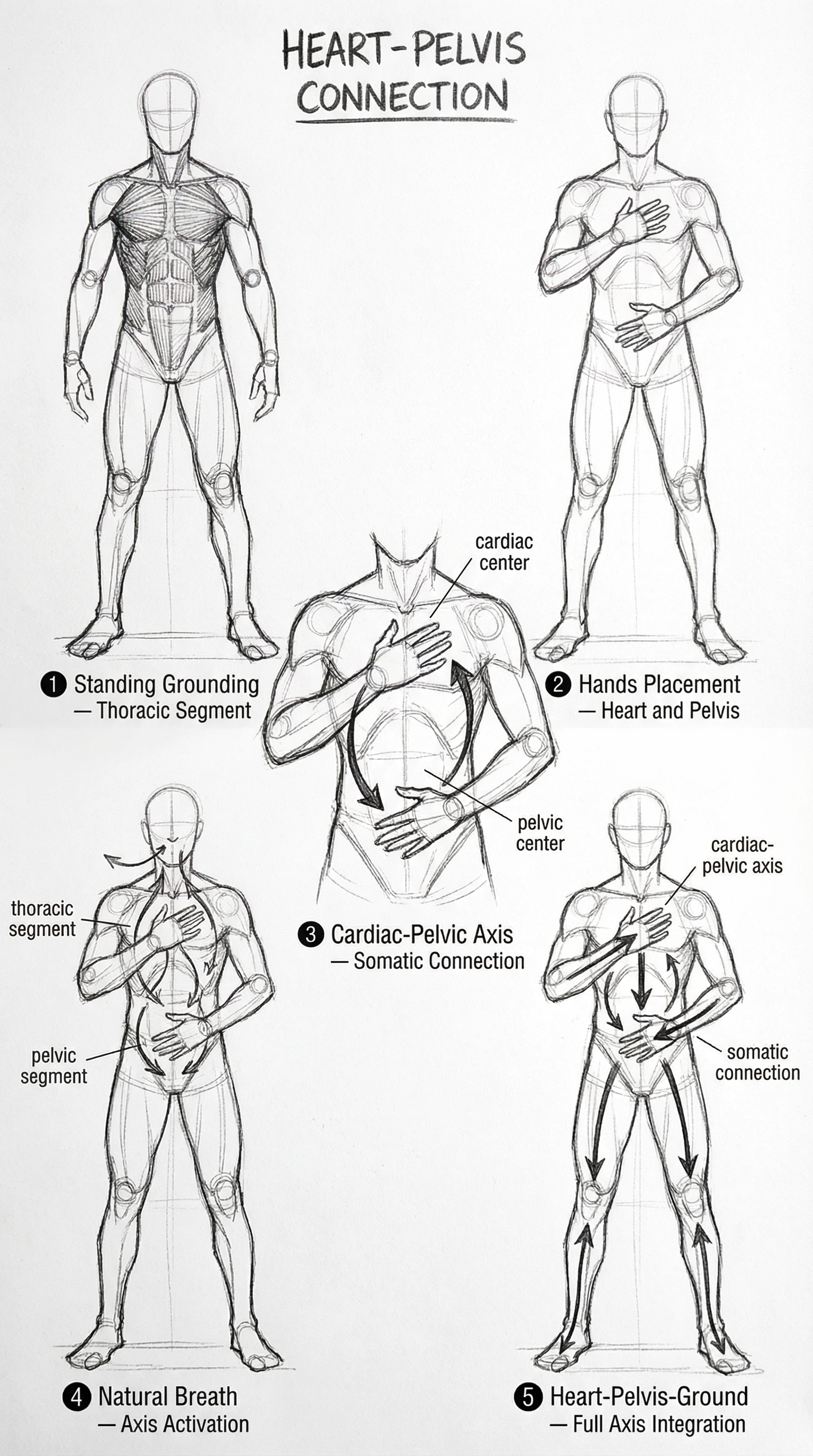
Heart-Pelvis Mobilization
“I can take pleasure in my feelings and vital powers”
With feet firmly planted on the floor and knees gently bent (grounding), place one hand over your heart (chest) and the other over your lower abdomen (below the navel). Begin a spontaneous, intuitive movement in the chest and abdomen area, activating and connecting these regions. Move freely with a sense of personal integration, breathing deeply and opening yourself to pleasurable sensations.
Use it when
when you want to connect feelings and aliveness through pleasure and lightness
What it is for
to harmonize feelings and aliveness/sexuality/vital power in a pleasurable way
About step 3. You will notice it sends you to a wall, nowhere near your jaw. That is on purpose. Going at the jaw and staying there can bring up more than you were ready for, so the sequence pulls away, works the back, and then comes back to close. It is not filler.
Where this comes from
The oral segment is the second of Reich's seven rings of muscular armor.
Body Anchor’s method is inspired by four foundational thinkers in
body-based psychotherapy. Their work is the lineage every sequence on this
site sits in.
Wilhelm Reich — Character analysis and the concept of muscular armor.
Alexander Lowen — Bioenergetic analysis and grounding-based bodywork.
David Boadella — Biosynthesis approach connecting movement and emotional process.
Gerda Boyesen — Biodynamic psychology and gentle somatic release work.
Questions people ask
Why does relaxing my jaw only last a few seconds?
The jaw is where the body parks an impulse it decided not to release: something unsaid, anger swallowed, a cry stopped halfway. A pattern built out of holding in does not answer to being told to let go. It answers to being allowed to move.
Why does the sequence send me to a wall, away from my jaw?
Going at the jaw and staying there can bring up more than you were ready for. The sequence deliberately moves away, works the back, and then comes back to settle.
Your jaw was one answer. What is yours?
The app asks what you feel and where you feel it, then builds the protocol for that exact pair. 218 exercises, three to ten minutes.