Five exercises, about five minutes. For the deep breath that stops halfway down.
5 exercises · about 5 minutes · nothing to buy, nothing to install
Short answer
The diaphragm is the fastest brake the body has. Hold your breath and you hold the feeling. When that becomes a habit the breath stops about two thirds of the way down, as if there were a lid.
The deep breath that stops halfway
Someone says take a deep breath. You try, and it gets about two thirds of the way down and stops, like there is a lid.
There is, in a sense. The diaphragm sits across the middle of you and it is the fastest brake the body has. When something needs to be held down quickly, that is the muscle that does it. Hold your breath and you hold the feeling. It works, which is the problem.
Breathing exercises alone often disappoint here, because you are asking a braced muscle to relax by using it harder. Sometimes it makes people dizzy or panicky, and then they conclude breathwork is not for them.
The sequence below gets at the diaphragm sideways, through the belly and the back, before asking anything of the breath itself. Five exercises rather than four. Take it slowly.
The exercises
Do them in this order and go slowly. If something feels like too much, stop and
breathe. That is part of the practice, not fine print.
Perception
Self-Awareness
“everything is here”
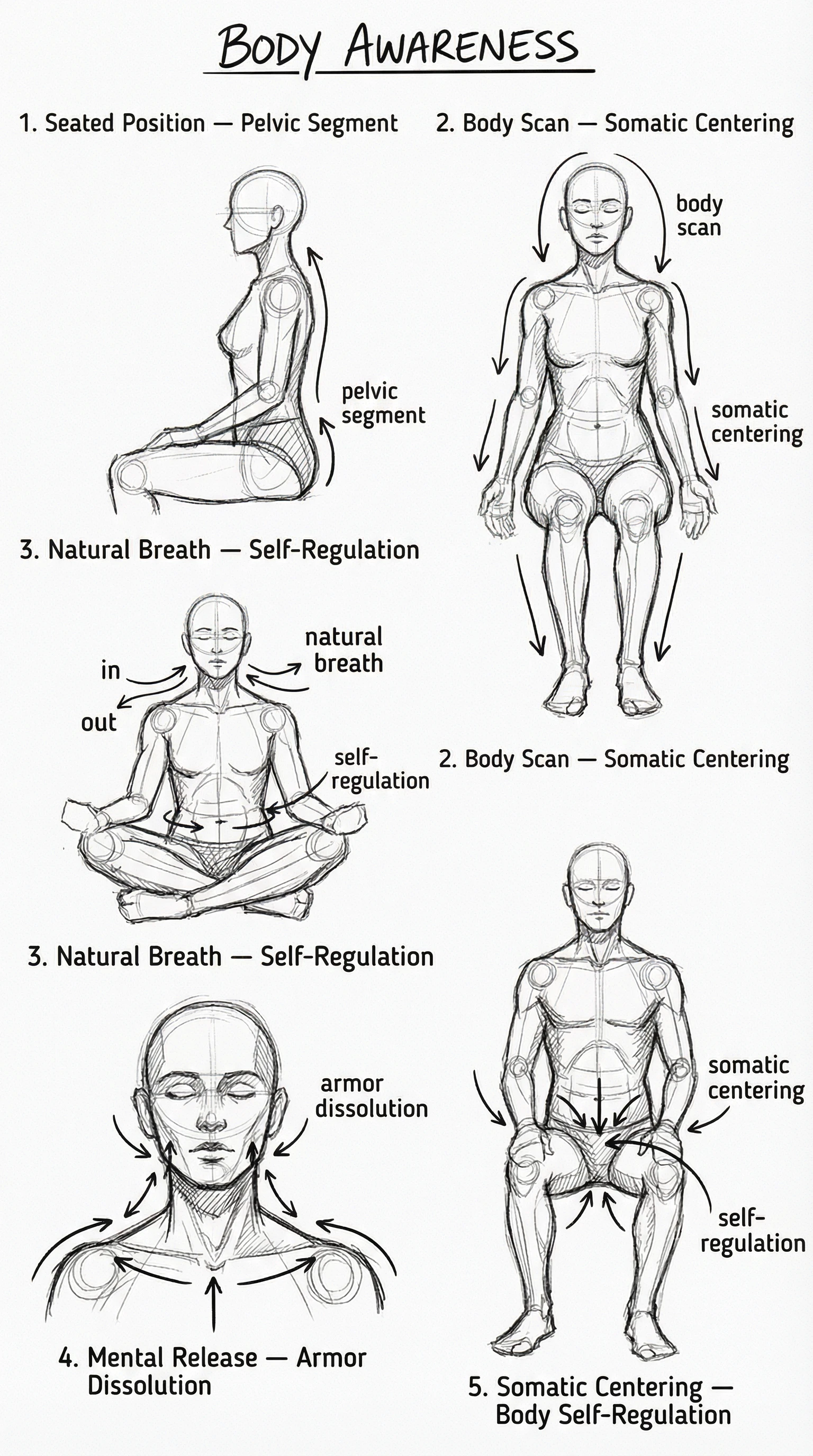
Position yourself comfortably. Keep the spine upright with minimal effort. Breathe naturally. Release perceived tensions through gentle mental intention, allowing self-regulation to arise organically.
Use it when
when you want to perceive and centrate yourself
What it is for
perceive yourself; allow the body to self-regulate through awareness and breath
Straight at it
Diaphragm Contact Touch
“I can find a place of greater calm and depth within myself”
Place your hands at stomach level and breathe deeply. Use a gentle, receptive touch, allowing the body to relax in its own time. Relax your shoulders, soften your mouth, and let your arms settle. Exhale deeply and deepen contact with the diaphragm through the respiratory movement of the belly — that is, through diaphragmatic breathing. Complete the exhale and practice diaphragmatic breathing (see image a and see image b).
Use it when
when you want to reconnect with your center of centration and vital-emotional organization
What it is for
release the diaphragm, connect with and receive the body, create inner space, release stress
Working around it
Cervical Touch
“I can support and relieve my head and thoughts”
Place both hands on the back of the neck in a firm and comfortable hold, letting your head relax into the support of your arms. Exhale deeply and allow your head to release as you feel the support provided by your hands. Bring presence to the touch so that your neck feels safe enough to let go.
Use it when
when you want to rest and support your neck
What it is for
open the head-body connection, depressurize, restore healthy streaming in the mind, relax, release tension
Straight at it
Dropped Jaw Release
“I can let my jaw drop”
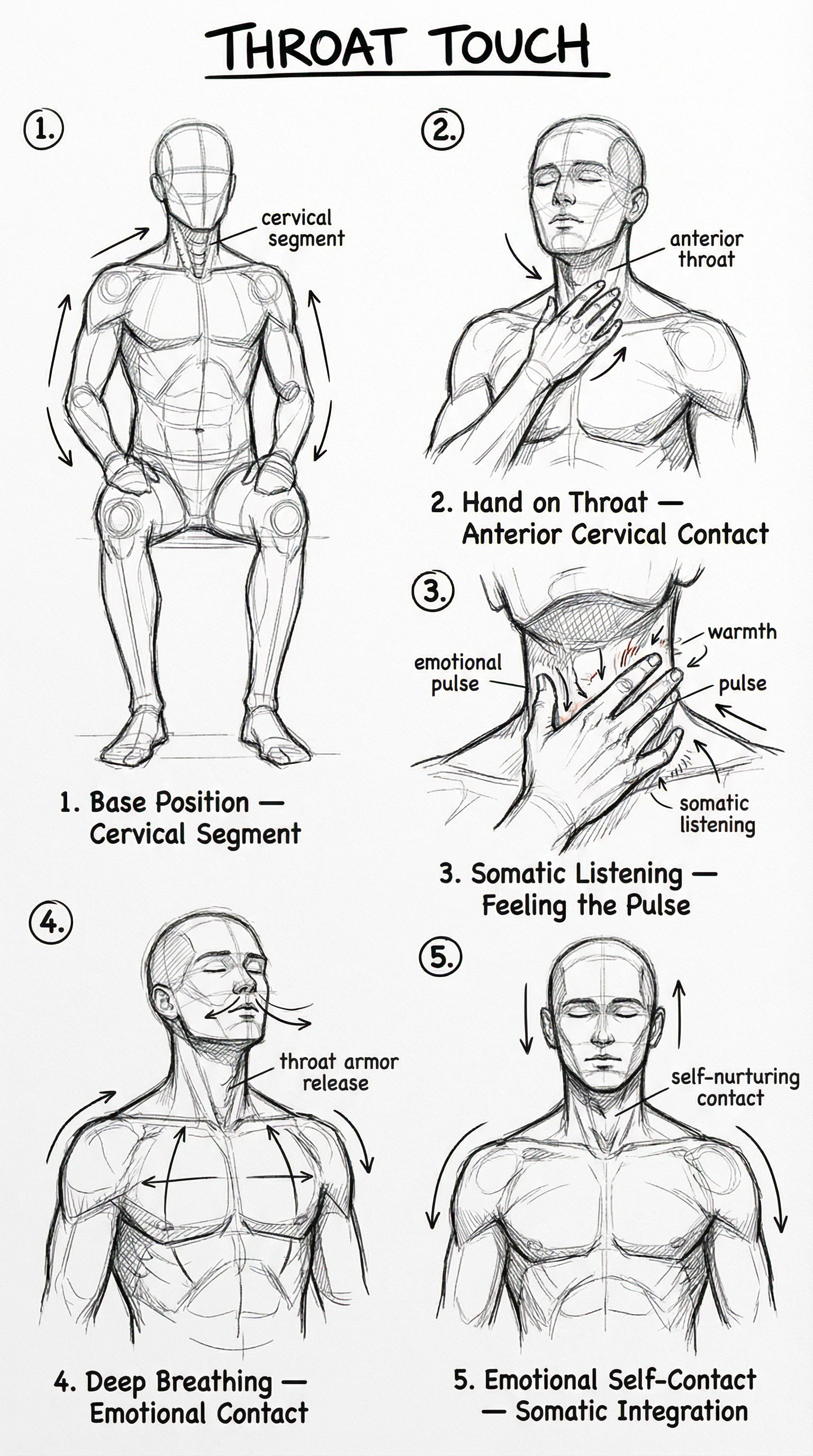
Grasp your jaw, pressing the index finger against the thumb, and massage the entire region. This movement can extend along the full edge of the jawline, on both the left and right sides. Whenever you press your fingers in, release the breath. When you ease your grip, inhale.
Use it when
when you want to allow yourself to feel your emotions and vulnerabilities more fully
What it is for
release tension in the jaw armored segment; loosen the holding pattern that keeps you braced against everything; allow yourself to yield in safety
Centring
Fetal Position
“I can always access my nest”
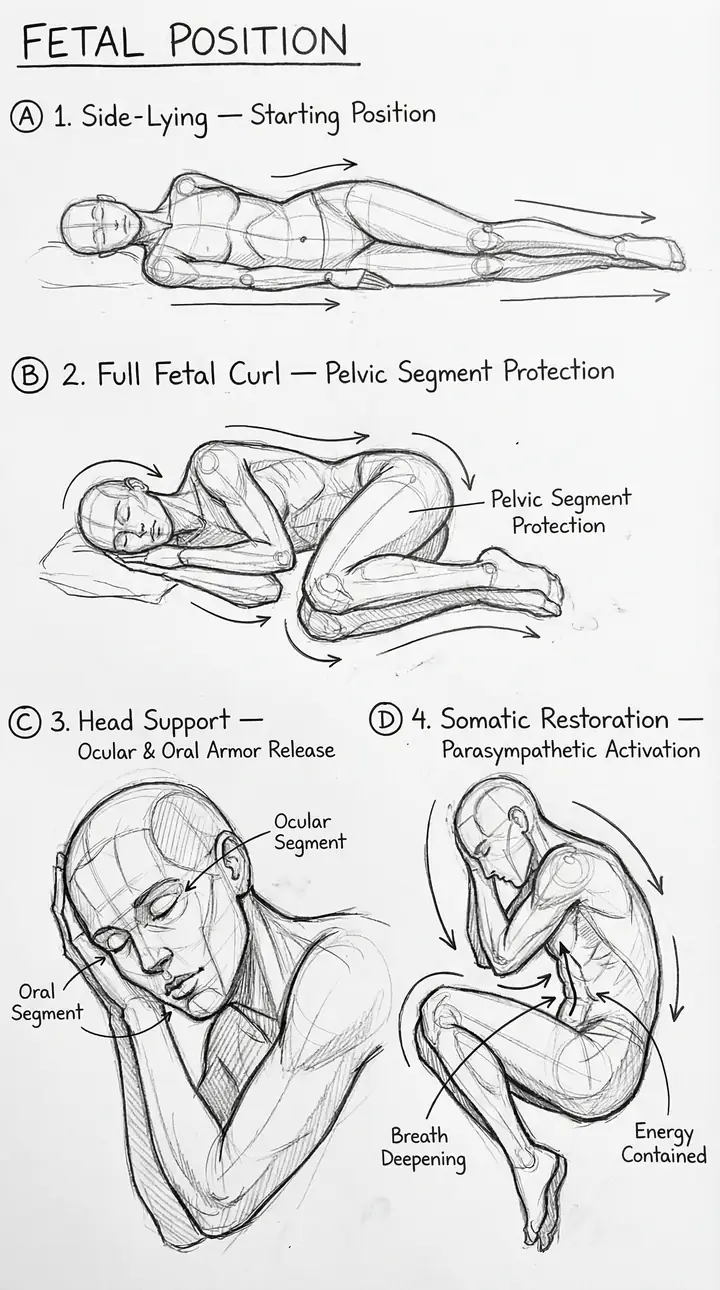
Lie comfortably on your side with legs drawn in and your trunk slightly curled toward your legs (fetal position). Use your arms to support your head in whatever way feels most comfortable, or adjust other body parts as needed — shoulders, face. Breathe deeply and rest in this place.
Use it when
when it is necessary to enter a highly protected and nurturing space
What it is for
to restore, momentarily close off from the world, pause, recover strength, and protect yourself
About the order. It looks shuffled and it is meant to be. Going straight at the tense place and staying there can bring up more than you were ready for, so the sequence pulls away, works somewhere else, and then comes back to close. The order is part of the protocol, not a detail.
Where this comes from
The diaphragmatic segment, fifth of Reich's seven rings, and the fastest brake the body has.
Body Anchor’s method is inspired by four foundational thinkers in
body-based psychotherapy. Their work is the lineage every sequence on this
site sits in.
Wilhelm Reich — Character analysis and the concept of muscular armor.
Alexander Lowen — Bioenergetic analysis and grounding-based bodywork.
David Boadella — Biosynthesis approach connecting movement and emotional process.
Gerda Boyesen — Biodynamic psychology and gentle somatic release work.
Questions people ask
Why does my deep breath stop halfway down?
The diaphragm is the fastest brake the body has. Hold your breath and you hold the feeling. When that becomes a habit the breath stops about two thirds of the way down, as if there were a lid.
Why do breathing exercises sometimes make me dizzy or panicky?
Because you are asking a braced muscle to relax by using it harder. This sequence reaches the diaphragm sideways, through the belly and the back, before asking anything of the breath itself.
Your breathing was one answer. What is yours?
The app asks what you feel and where you feel it, then builds the protocol for that exact pair. 218 exercises, three to ten minutes.