How to Release Tension in Your Hips and Lower Back
Five exercises, about five minutes. For hips that never quite loosen and a back that tightens whenever things get hard.
5 exercises · about 5 minutes · nothing to buy, nothing to install
Short answer
The pelvis carries your weight and also holds a great deal the body does not discuss. It is the least talked about region and often the most guarded, which is why it stays stuck.
The base of everything above it
The lower back goes first when things get hard. Deadline week, difficult conversation, bad news, and there it is.
The pelvis carries your weight and it is also where the body holds a great deal that it does not discuss. It is the least talked about region and often the most guarded, which is exactly why it stays stuck.
There is a practical consequence too. Everything above the pelvis rests on it. Shoulders that will not release sometimes will not release because the base underneath them is locked, and no amount of work on the shoulders changes that.
Five exercises here. Some of them will feel unfamiliar rather than difficult. Unfamiliar is fine.
The exercises
Do them in this order and go slowly. If something feels like too much, stop and
breathe. That is part of the practice, not fine print.
Perception
Self-Awareness
“everything is here”
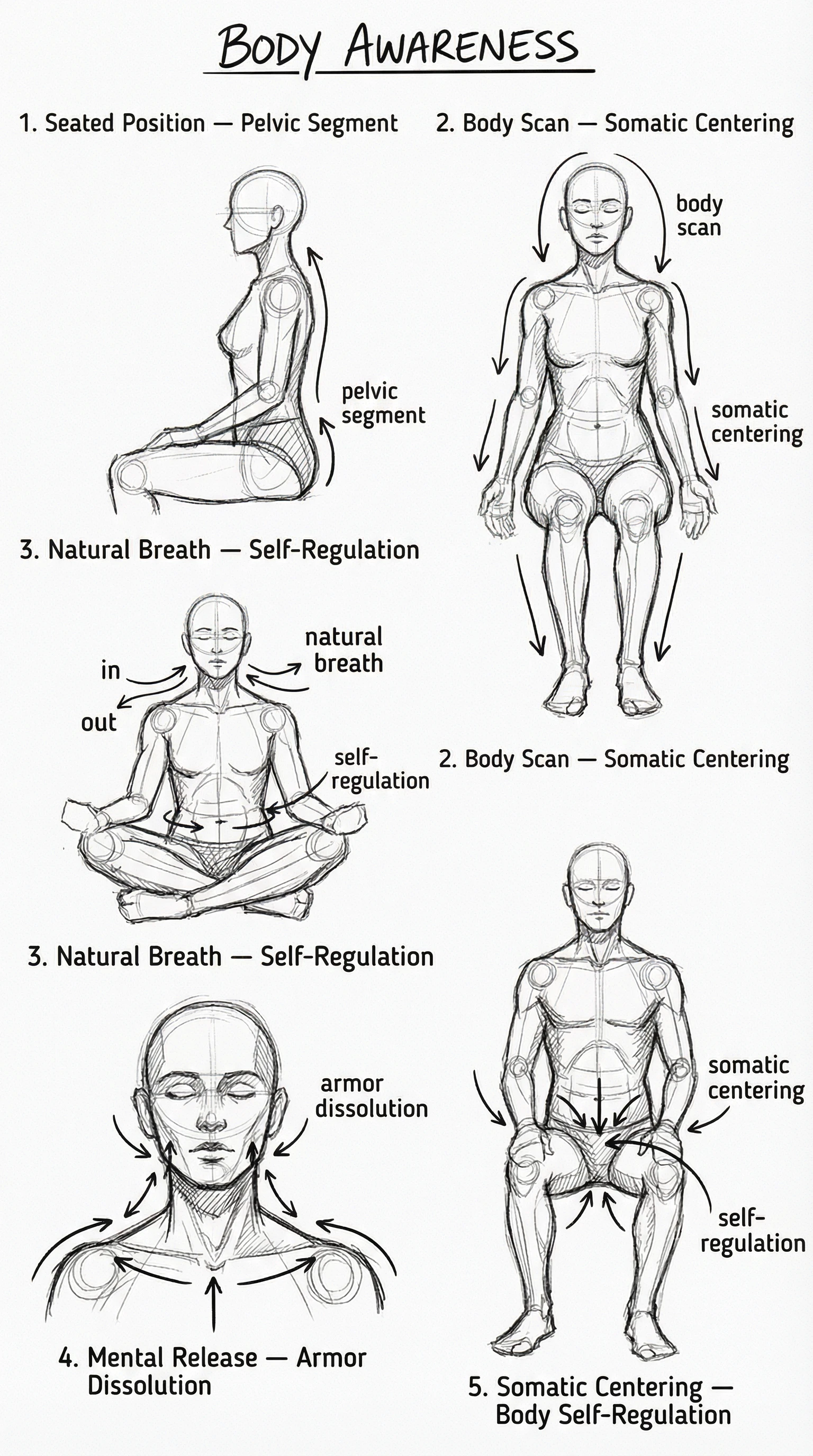
Position yourself comfortably. Keep the spine upright with minimal effort. Breathe naturally. Release perceived tensions through gentle mental intention, allowing self-regulation to arise organically.
Use it when
when you want to perceive and centrate yourself
What it is for
perceive yourself; allow the body to self-regulate through awareness and breath
Straight at it
Floor Gluteal Release
“I have space to be within myself”
Lie in lying grounding on the floor and draw one leg toward your chest, holding behind the knee and at the ankle (see image a). Or perform the full movement by crossing one leg over the other and lifting the leg and knee upward as if doing a ceiling grounding (inverted ceiling grounding) — see main image. Use your hand to pull the leg toward your chest, deepening the stretch and decompressing tension in the hip. Settle into this position and breathe deeply, allowing the gluteal muscles to release and your legs to integrate. Then repeat the same movement with the other leg.
Use it when
when you want to expand the emotional and vital foundation of your body
What it is for
integrate and expand the streaming of energy in the pelvis and legs
Working around it
Mental Displacement
“my head needs me in order to self-regulate”
Perform the entire process with the mouth open. In a comfortable position, use your fingers to massage or gently grip the scalp in place (anchoring the fingers at points on the head to produce a light movement of the scalp). You can also grab tufts of hair and pull in a pleasurable way, or simply move the scalp. Explore the front, back, and sides, discovering areas of pleasure and relief.
Use it when
when you need to relieve the mind and 'shift' repetitive thoughts
What it is for
relieve mental tension, overload, and excess activity in the head; open yourself to new ways of releasing
Straight at it
Ocular Breathing
“I can become clearer and gain more mental clarity by softening the way I see the world”
Inhale and strongly contract the ocular region — squeezing the eyes shut. Then exhale and relax, opening your eyes wide. It is important that the exhale carries a soft 'aah' sound. Allow your eyes to tear or your mouth to move expressively from time to time. If you wish, hold a position for a few seconds, and blink gently as needed.
Use it when
when you need to decompress the head, relieve the overload in the eyes and in racing thoughts
What it is for
pulsate the ocular armored segment to clear mental tension and release eye strain
Centring
Full Neck Rotation
“I can release, open, revisit, and let go of all the angles that trouble and tense my mind and heart”
Slowly rotate your head in a full circle, passing through every point at its maximum range. Go downward, letting the head drop fully, and so on. Always release forward to free tension. Keep the spine erect throughout and move only your neck — your maximum range of motion is most effective. If you feel a painful or difficult spot, slow down and, if needed, pause there. Breathe into it. You may rotate in both directions for as long as you like. Be gentle and unhurried.
Use it when
when you want to open new possibilities
What it is for
notice and release neck tensions; free mental overload and excessive control; open more connection with your feelings and your body
About the order. It looks shuffled and it is meant to be. Going straight at the tense place and staying there can bring up more than you were ready for, so the sequence pulls away, works somewhere else, and then comes back to close. The order is part of the protocol, not a detail.
Where this comes from
The pelvic segment, seventh and last of Reich's seven rings, with Lowen's grounding underneath it.
Body Anchor’s method is inspired by four foundational thinkers in
body-based psychotherapy. Their work is the lineage every sequence on this
site sits in.
Wilhelm Reich — Character analysis and the concept of muscular armor.
Alexander Lowen — Bioenergetic analysis and grounding-based bodywork.
David Boadella — Biosynthesis approach connecting movement and emotional process.
Gerda Boyesen — Biodynamic psychology and gentle somatic release work.
Questions people ask
Why does my lower back tighten under stress?
The pelvis carries your weight and also holds a great deal the body does not discuss. It is the least talked about region and often the most guarded, which is why it stays stuck.
Can tight hips cause tight shoulders?
They can. Everything above the pelvis rests on it. Shoulders sometimes refuse to release because the base underneath them is locked, and working the shoulders alone changes nothing.
Your hips were one answer. What is yours?
The app asks what you feel and where you feel it, then builds the protocol for that exact pair. 218 exercises, three to ten minutes.