Four exercises, about five minutes. For the knot that shows up before anything difficult.
4 exercises · about 5 minutes · nothing to buy, nothing to install
Short answer
The belly is soft and unprotected and the body treats it that way. It braces ahead of what it expects, which is why your stomach knows before you can explain it.
The knot that arrives before the bad news does
You know this one before you can explain it. Something is coming and your stomach knows first.
The belly is soft and unprotected and the body treats it that way. It is also where a lot of people hold constantly for reasons that have nothing to do with fear, because they were told to pull it in and never stopped.
Either way the effect is the same. A belly held tight does not let the breath down, and a breath that cannot get down keeps everything above it slightly on alert.
The exercises below ask you to let the belly be soft, which sounds easy and is not. If you notice yourself pulling it in again halfway through, that is the pattern. Just let it go and carry on.
The exercises
Do them in this order and go slowly. If something feels like too much, stop and
breathe. That is part of the practice, not fine print.
Perception
Self-Awareness
“everything is here”
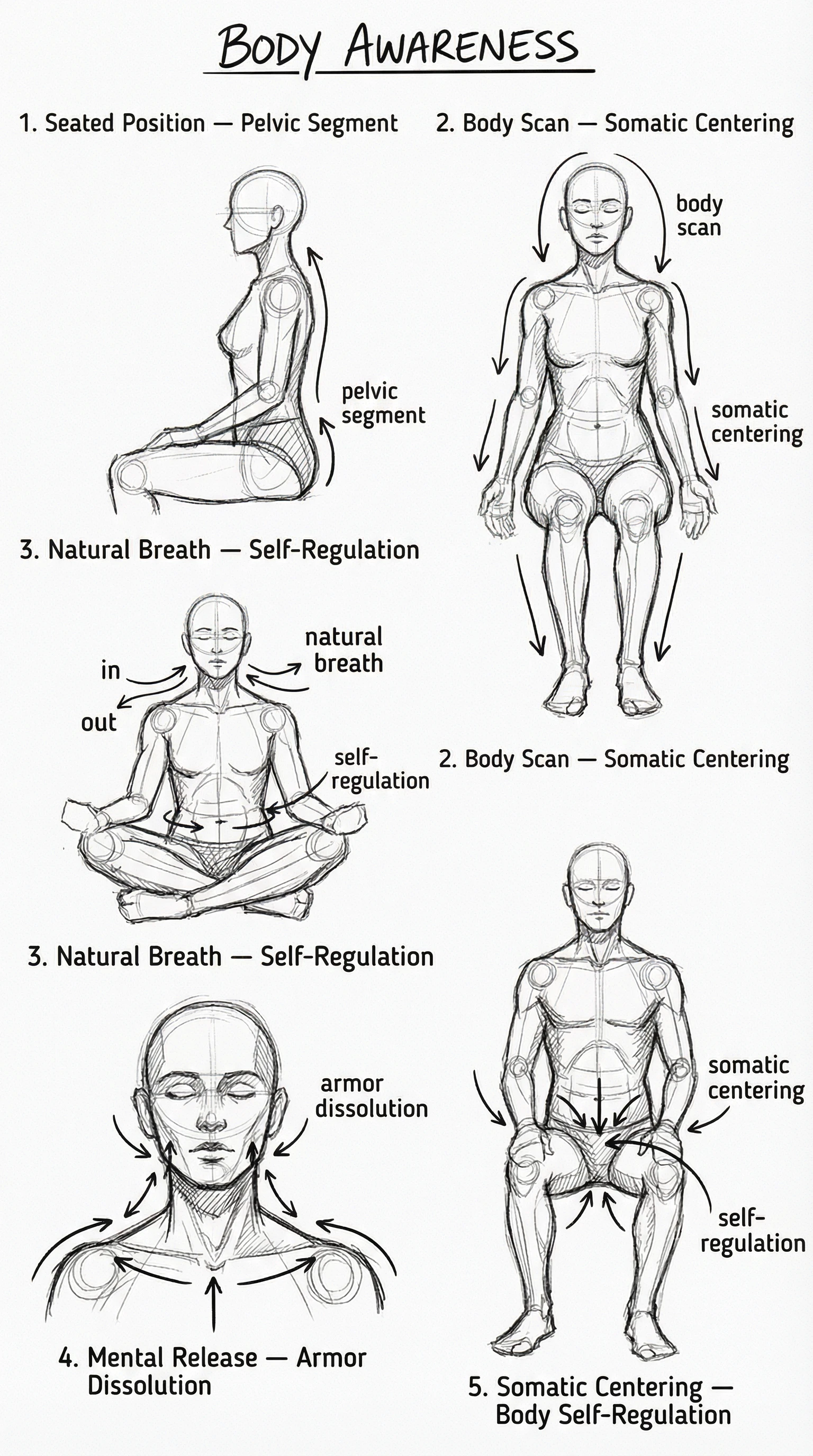
Position yourself comfortably. Keep the spine upright with minimal effort. Breathe naturally. Release perceived tensions through gentle mental intention, allowing self-regulation to arise organically.
Use it when
when you want to perceive and centrate yourself
What it is for
perceive yourself; allow the body to self-regulate through awareness and breath
Straight at it
Deep Diaphragm Touch
“I can release spaces of tension within me”
Touch the solar plexus area with a deep, penetrating touch — sinking your fingertips into the belly as if reaching inside. Do this with firmness and self-care, going as deep as your body allows in that moment. Stay in this touch while breathing, maintaining steady pressure throughout. Let your breath move through the belly and chest; if possible, allow full diaphragmatic movement so that your hand is pushed outward by the belly on the inhale. Complete the central touch, then move to the left and right sides. You may also deepen the pressure there.
Use it when
when you want to expand your breathing and discharge pressure, stress, and visceral tension from the body — especially from the belly
What it is for
to activate, stimulate, and release diaphragmatic tension, discharge stress, and expand aliveness
Working around it
Mouth Brushing
“I can expand my emotional palate”
Run your tongue around the inside of the mouth in all directions — along the cheeks, every angle, over the teeth, reaching as far as possible. Make circular and straight movements, exploring as much as you can. You can imagine you are emotionally brushing the interior of your mouth. Breathe consciously while performing the movements. Moving without breathing does not release physical tension or emotions.
Use it when
when you need to clear repetitive emotional patterns
What it is for
clear habitual patterns around how you experience and taste life; cleanse the emotional lining of the body
Centring
Fetal Position
“I can always access my nest”
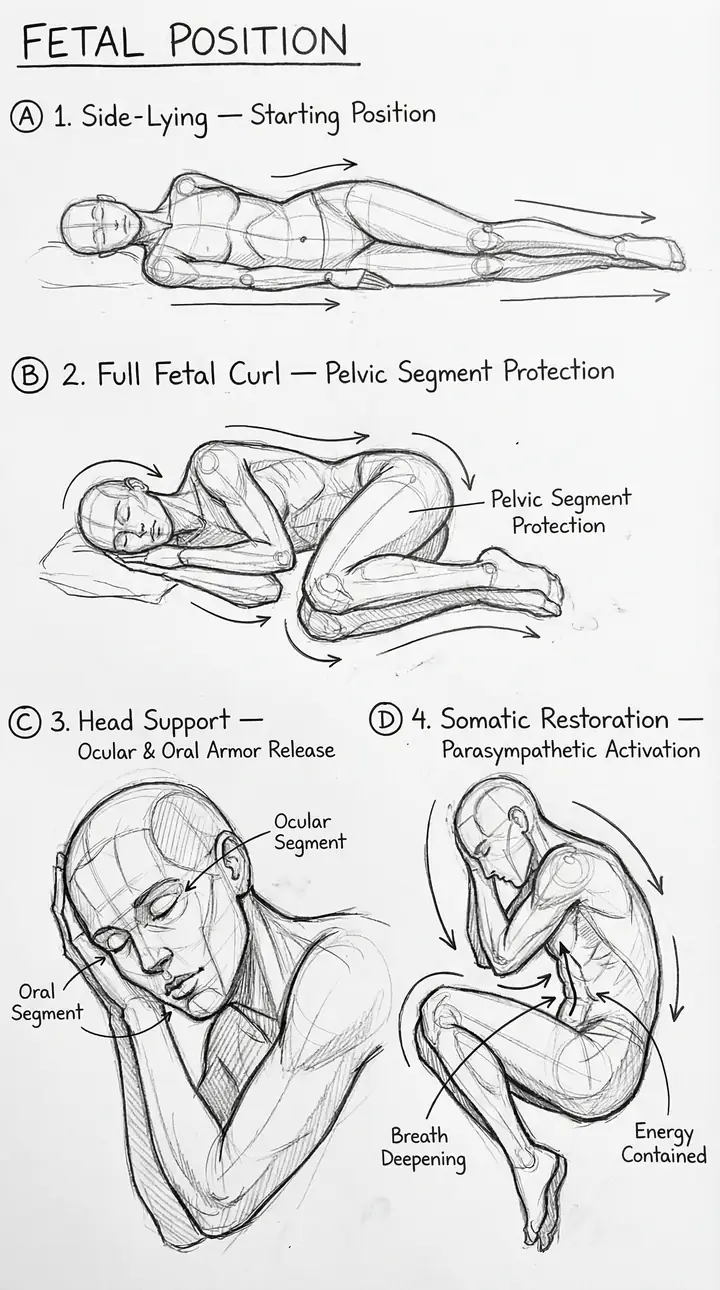
Lie comfortably on your side with legs drawn in and your trunk slightly curled toward your legs (fetal position). Use your arms to support your head in whatever way feels most comfortable, or adjust other body parts as needed — shoulders, face. Breathe deeply and rest in this place.
Use it when
when it is necessary to enter a highly protected and nurturing space
What it is for
to restore, momentarily close off from the world, pause, recover strength, and protect yourself
About the order. It looks shuffled and it is meant to be. Going straight at the tense place and staying there can bring up more than you were ready for, so the sequence pulls away, works somewhere else, and then comes back to close. The order is part of the protocol, not a detail.
Where this comes from
The abdominal segment, sixth of Reich's seven rings, approached through the contact work Boyesen developed.
Body Anchor’s method is inspired by four foundational thinkers in
body-based psychotherapy. Their work is the lineage every sequence on this
site sits in.
Wilhelm Reich — Character analysis and the concept of muscular armor.
Alexander Lowen — Bioenergetic analysis and grounding-based bodywork.
David Boadella — Biosynthesis approach connecting movement and emotional process.
Gerda Boyesen — Biodynamic psychology and gentle somatic release work.
Questions people ask
Why does my stomach knot before something difficult?
The belly is soft and unprotected and the body treats it that way. It braces ahead of what it expects, which is why your stomach knows before you can explain it.
Why is letting my belly be soft so hard?
Many people hold constantly for reasons that have nothing to do with fear, because they were told to pull it in and never stopped. A belly held tight does not let the breath down.
Your belly was one answer. What is yours?
The app asks what you feel and where you feel it, then builds the protocol for that exact pair. 218 exercises, three to ten minutes.